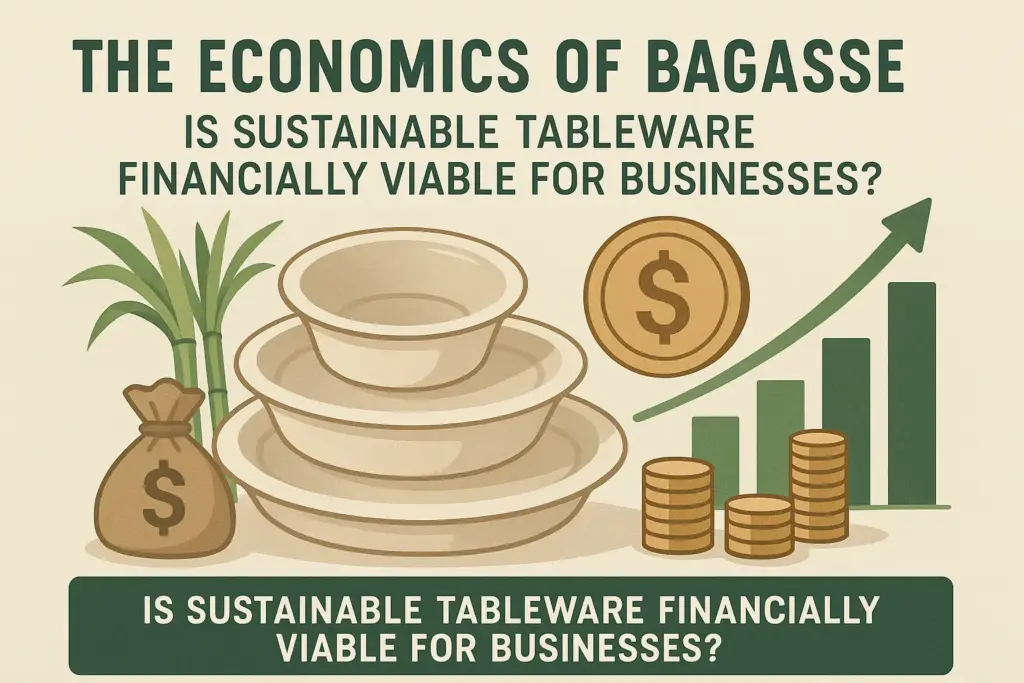
Almost every disposable plate sold today calls itself eco friendly. Some are; many are paper with a plastic coat, or plant fibre held together with resin. This guide explains the main types of biodegradable plates sold in India, what the labels really mean, what to ask a supplier before a bulk order, and the sizes Pulpcraft makes.
Table of Contents
The main types of biodegradable plates
Four materials make up most of what is sold as biodegradable plates in India. They behave very differently with Indian food:
| Material | What it is | Strengths | Watch out for |
|---|---|---|---|
| Bagasse | Sugarcane fibre left after juice extraction, pressed into shape | Holds hot gravy and oil, consistent shape, microwave-safe | Quality varies by maker; check thickness and weight |
| Areca leaf | Fallen areca palm sheaths, pressed and trimmed | Natural look, rigid | Seasonal raw material, each plate looks different, limited shapes |
| Paper | Paperboard, often with a coating | Low cost, easy to find | Uncoated paper soaks up gravy; coated paper may have a plastic layer that does not compost well |
| Bamboo fibre | Bamboo pulp, sometimes mixed with binders | Strong, smooth finish | Ask what binder is used; some products are not compostable |
We have compared these head to head: bagasse vs areca leaf, bagasse vs paper and bagasse vs bamboo. And unlike plastic plates and Styrofoam, all four avoid India’s single-use plastic ban, provided they have no plastic layer.
Biodegradable, compostable and eco friendly are not the same
These words get used as if they mean the same thing. They do not. Biodegradable means a material breaks down eventually, with no time limit attached. Compostable is stricter: it means the material breaks down into compost under composting conditions within a set period, without leaving harmful residue. Eco friendly has no fixed meaning at all. Our article on biodegradable vs compostable vs recyclable explains the difference in detail.
For a buyer, the practical point is this: a plate labelled eco friendly may still carry a plastic coating, and a plate labelled biodegradable may not be compostable in any reasonable time. Ask what the plate is made of, whether it has any coating or lining, and what test reports back the claim.
Buying biodegradable plates in bulk?
Tell us your menu, the sizes you need and your monthly or event quantity. We will send a quote and samples you can test with your own food.
Why labels mislead and performance gets overlooked
Most marketing for eco friendly plates talks about the planet and says little about the food. A restaurant or caterer needs a plate that:
- Holds hot food without softening (see our notes on hot and oily food)
- Resists oily gravy without leaking through
- Keeps its shape when carried or delivered
- Is the same thickness and finish in every batch
Two sugarcane plates can look identical and perform very differently. The difference comes from fibre density, how hard the fibre is pressed, the moulding process and quality control. Cheap plates usually save money by using less fibre, so they feel light, soften quickly with dal and vary from batch to batch. For a business, that shows up as plates thrown away, guests taking two plates and complaints. Our list of red flags when buying bagasse plates shows what to look for.
What to ask a supplier before a bulk order
- What is the plate made of? Get the material in writing, and ask whether there is any coating, lining or binder.
- Is it food-grade? Ask for food-contact test reports from an independent lab. Read is bagasse tableware safe for what these cover.
- What certifications does the factory hold? Food safety and quality management certificates show the plant runs controlled processes, not one good sample.
- What does each plate weigh? Weight is a quick check on fibre content. Compare it with the samples when the bulk order arrives.
- Is it microwave-safe? Useful for reheating in canteens and homes. Bagasse is; see are bagasse plates microwave safe.
- Who makes it? A manufacturer can repeat the same specification; a trader may source from different factories each time.
Pulpcraft biodegradable plate sizes
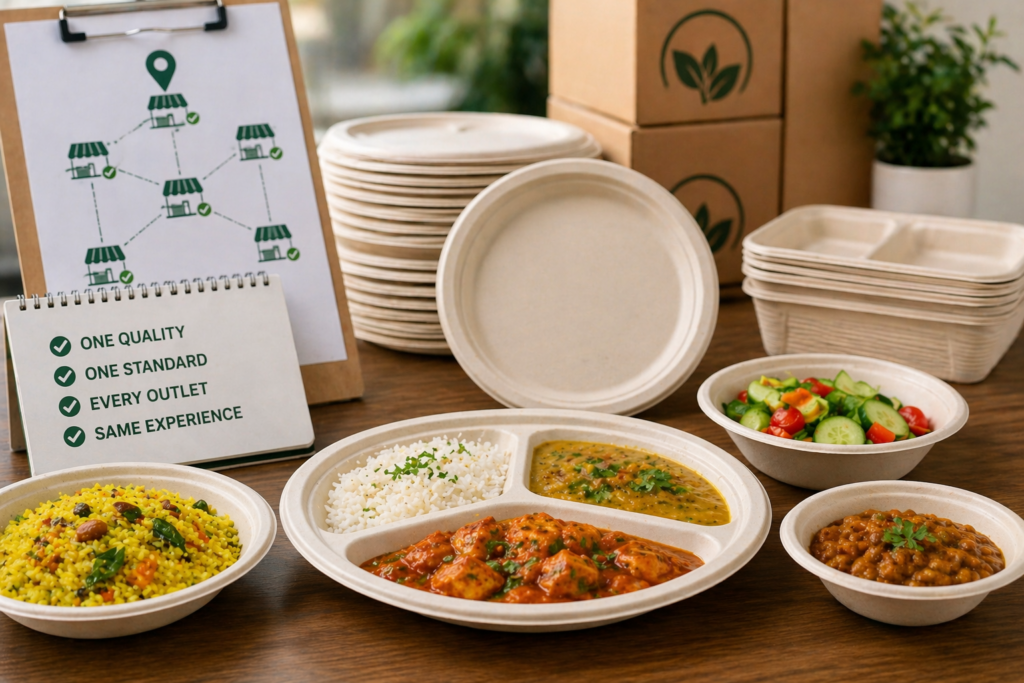
Pulpcraft makes bagasse plates from sugarcane bagasse with no plastic or wax lining. If you are new to the material, start with what bagasse tableware is. The round plates cover snacks to full meals, and the compartment plates suit thalis and canteens. The 12 inch 4 compartment plate is the most popular for events and community meals, because it keeps four dishes apart on one plate.
| Product | Size | Depth | Weight | Per packet | Per box |
|---|---|---|---|---|---|
| 6 inch Deep Round Plate | 150 mm | 25 mm | 7 g | 50 | 2,000 |
| 7 inch Deep Round Plate | 175 mm | 25 mm | 8 g | 50 | 1,500 |
| 9 inch Round Plate | 225 mm | 18.5 mm | 14 g | 25 | 1,000 |
| 10 inch Round Plate | 250 mm | 22 mm | 19 g | 25 | 500 |
| 11 inch Round Plate | 278 mm | 24.5 mm | 21 g | 25 | 500 |
| 12 inch Round Plate | 305 mm | 24.5 mm | 25 g | 25 | 500 |
| 10 inch 3 Compartment Plate | 250 mm | 22 mm | 19 g | 25 | 500 |
| 11 inch 4 Compartment Plate | 278 mm | 24.5 mm | 22 g | 25 | 500 |
| 12 inch 4 Compartment Plate | 305 mm | 24.5 mm | 26 g | 25 | 500 |
We also make bowls and meal trays in the same material.
Who buys biodegradable plates in bulk
- Restaurants, hotels and caterers: see how the HORECA sector uses bagasse, and our guide on how restaurants can replace plastic without disrupting service.
- Cloud kitchens: our cloud kitchen packaging guide matches containers to dishes.
- Event planners and wedding caterers: large one-off orders where the plate has to hold heavy food.
- Temples, community kitchens and canteens: high volumes every day, usually on compartment plates.
- Retailers and distributors: stocking packs for shops and online sale.
After use: composting
Bagasse plates break down in commercial composting and can be composted at home too, though that takes longer. Our composting tips explain how. Plates with a plastic coating do not break down the same way, which is one more reason to ask about coatings before you buy.
Buy direct from the manufacturer
Pulpcraft makes every plate, bowl and tray at its own plant in Kaimur, Bihar. The plant holds BRCGS (Packaging Materials, Grade A), ISO 9001, ISO 14001, ISO 45001 and ISO 22000 certification, with SGS and CIPET test reports on the products. You can see the certificates on the About page. We sell bagasse plates in full boxes for businesses and buyers ordering wholesale. For everyday bulk supply see our page on use and throw plates, and to compare every material for Indian food, read our guide to the best disposable plates.
FAQs
Which biodegradable plate is best for Indian food?
Bagasse plates handle hot dal, curry and oily food better than paper, and are more consistent in shape and supply than areca leaf plates.
Are biodegradable plates the same as compostable plates?
No. Biodegradable means it breaks down eventually; compostable means it breaks down into compost within a set time under composting conditions. Bagasse plates are compostable.
Are paper plates biodegradable?
Uncoated paper is. Many paper plates carry a plastic coating to stop gravy soaking through, and these do not compost well. Ask the supplier.
Are eco friendly disposable plates safe for hot food?
Bagasse plates are food-grade and hold hot food. Check test reports for any material before buying in bulk.
Can I buy biodegradable plates online in small packs?
We supply businesses in full boxes. Box counts for each size are in the table above; contact us for the minimum order.
How do I check quality when the bulk order arrives?
Weigh a few plates against the samples, check thickness and edges, and serve your hottest dish on one before you use the batch.
Order biodegradable plates direct from the factory
Send your sizes and quantity for a quote, or call us to talk through your menu and volumes.