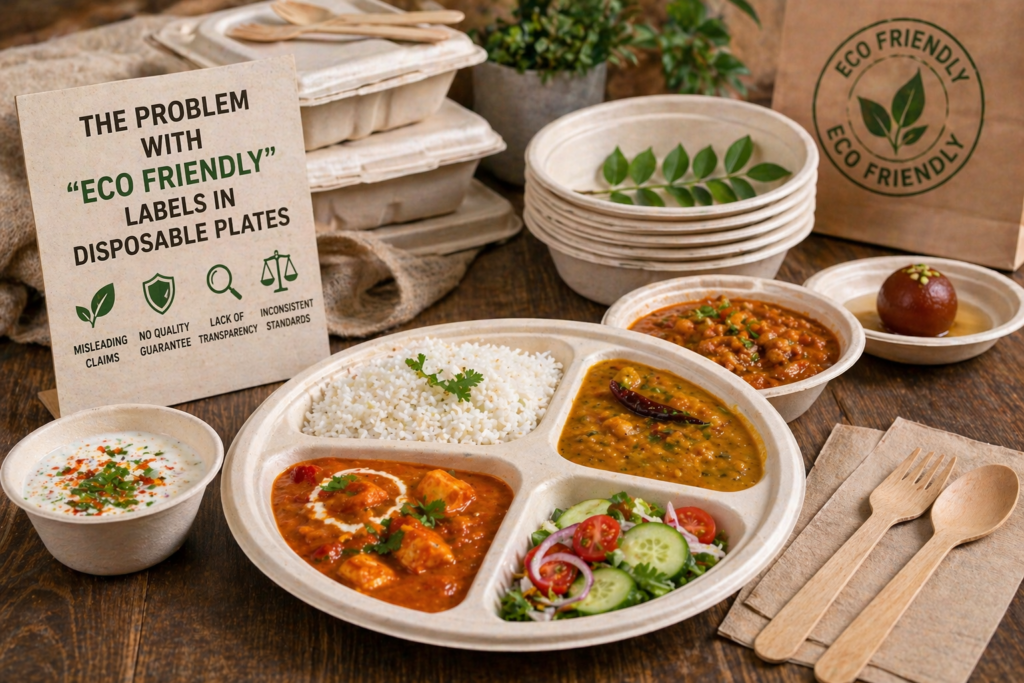
Three words on every green label, constantly mixed up, and only one of them means much for food packaging.
All three words describe how packaging ends its life, but they are not equal. Biodegradable is a vague, unregulated claim. Recyclable works only for clean materials, not greasy food boxes. Compostable, backed by CPCB and IS/ISO 17088 certification, is the one that actually turns food packaging into soil within 90 to 180 days, so it is the standard to trust. Natural fibres like bagasse meet it without any tricks.
Who this is for: restaurant and cloud-kitchen owners, caterers, event planners, packaging buyers and eco-conscious shoppers in India who need to choose, verify or explain food-packaging claims.
Table of Contents
Why These Three Words Matter
Walk down any aisle or read any takeaway box and you will see the words. Biodegradable. Compostable. Recyclable. They are printed like they mean the same thing, a friendly nod to the planet, and most of us nod back without checking.
The problem is that they do not mean the same thing at all. This guide breaks down each term in plain language, shows where they differ, and explains which one to trust for anything food touches.
What Is the Quick Difference Between the Three?
Short answer: Biodegradable is a loose claim with no time limit, compostable is a tested standard that turns waste into clean soil in 90 to 180 days, and recyclable reprocesses clean materials but rarely works for greasy food packaging. The table below lays them out side by side.
| Term | What it really means | Time and conditions | The catch |
| Biodegradable | Anything microbes can eventually break down. It is a broad, loosely used word. | No fixed time and no set conditions. Could mean months or twenty years. | Unregulated, so it is the favourite word of greenwashing. Some so-called biodegradable plastics just shatter into microplastics. |
| Compostable | A stricter, tested subset. It breaks down into nutrient-rich soil and leaves no toxic residue. | Usually 90 to 180 days, in defined composting conditions. Home-compostable grades work in a garden pit. | Needs the right end-of-life setting, and it should carry real certification such as CPCB and IS/ISO 17088. |
| Recyclable | Can be collected, reprocessed and made into new products rather than composted. | Only if it is clean, sorted and actually collected for recycling in your area. | Food-soiled and greasy packaging usually cannot be recycled, and quality drops with each cycle. |
What Does ‘Biodegradable’ Actually Mean?
Short answer: It means microbes can eventually break the material down, but with no set time or conditions, which makes it the weakest and most misused of the three claims.
Technically, biodegradable just means that living microbes can eventually break the material down into water, carbon dioxide and biomass. Sounds great, until you notice the two missing pieces: how long and under what conditions.
A material that takes twenty years in a landfill and leaves chemical traces behind can still be called biodegradable, because there is no rulebook forcing a time limit or a clean result. Given enough time, almost everything is biodegradable in the loosest sense.
That vagueness is exactly why the word is a magnet for greenwashing. The worst example is oxo-degradable plastic, ordinary fossil-fuel plastic with an additive that makes it crumble into tiny fragments. It was sold for years as biodegradable, but all it really does is turn one visible piece of plastic into countless invisible microplastics.
It has since been recognised as an environmental problem and banned in India and parts of Europe. So when a label says only biodegradable and nothing more, treat it as a question, not an answer.
What Does ‘Compostable’ Mean, and Why Is It Better?
Short answer: Compostable is a tested subset of biodegradable. It breaks down into nutrient-rich soil with no toxic residue, usually within 90 to 180 days, and in India it should carry CPCB approval and meet the IS/ISO 17088 standard.
For a material to earn the word properly, it has to break down within that defined time into compost that feeds soil rather than poisoning it, leaving no plastic fragments behind. There is a genuine standard behind it and, in India, real certification to look for. Two things are worth knowing:
Industrial vs Home Composting
Some compostable items need the higher heat and humidity of a commercial composting facility. Others, including natural fibres, break down in an ordinary garden compost pit at home. The label should tell you which.
Look for the Certification
In India, properly compostable products carry CPCB (Central Pollution Control Board) approval and meet the IS/ISO 17088 standard. A CPCB logo and registration number is the difference between a tested claim and a hopeful one.
Is ‘Recyclable’ the Same as Compostable?
Short answer: No. Recycling reprocesses clean materials into new products, but greasy, food-soiled packaging usually cannot be recycled at all, which is why compostable is the better fit for food service.
Recyclable means the material can be collected, cleaned, reprocessed and turned into something new. For clean, dry, rigid items like a glass bottle or a steel can, recycling is excellent and should always be the first choice.
But recycling has three quiet conditions that trip up food packaging:
- The item has to be clean.
- It has to be sorted correctly.
- There has to be a system that actually collects and processes it near you.
Food packaging usually fails the first test. A pizza box soaked in grease, a curry container smeared with oil, a plate with rice stuck to it – these are typically rejected by recyclers because the food contamination ruins the process.
So a box may be recyclable on paper and still end up in a landfill because no one can recycle it once your biryani has been in it. For oily, food-soiled packaging, compostable usually beats recyclable, because the food residue that blocks recycling is welcome in composting.
Which Is Best for Food Packaging?
Short answer: Compostable. A soiled compostable plate turns into soil, food scraps and all, while a greasy recyclable box is usually landfilled and a plain biodegradable claim guarantees nothing.
For food service the order runs like this:
- Compostable is the goal, because a soiled compostable plate becomes soil rather than waste.
- Recyclable is great for clean, non-food items but rarely helps a greasy takeaway box.
- Biodegradable, on its own, is the weakest claim of the three and often means very little without a certified compostable standard sitting behind it.
The eco-friendly badge to actually trust on a food container is a certified compostable one.
Here is a simple real-world example. Smear a certified compostable bagasse plate with leftover curry and drop it in a home compost pit, and in about two to three months it is soil. Put the same meal in a plastic clamshell, and most recyclers will reject the oily box, so it goes to landfill for centuries. Same food, two very different endings, decided entirely by the material.
Where Does Bagasse Fit in the Hierarchy?
Short answer: Right at the top for food use. Bagasse is natural sugarcane fibre that is truly compostable in about 60 to 90 days, at home or industrially, with no plastic coating to leave anything behind.
Bagasse, the fibre left after sugar mills crush the juice from sugarcane, lands in the best possible spot. It is not a plastic dressed up with a green word. It is natural plant fibre with no synthetic coating, which means it is truly compostable and works in home and industrial composting alike.
Because it is made from crop waste, it also avoids the trees and petroleum behind paper and plastic. A bagasse plate that carried your oily lunch can go into a compost pit and come back as soil, which is the outcome all three words are supposed to be reaching for.
How to Tell a Real Claim From Greenwashing
Short answer: Trust ‘compostable’ plus a CPCB logo, a registration number and the IS/ISO 17088 standard. Be wary of ‘biodegradable’ used on its own, and avoid oxo-degradable entirely.
- Be wary of biodegradable on its own. With no time, no conditions and no certification, it is the vaguest thing a label can say.
- Look for compostable plus a certification. In India that means a CPCB logo and registration number and the IS/ISO 17088 standard.
- Check home versus industrial. If you have no access to a composting facility, a home-compostable material is the practical choice.
- Avoid oxo-degradable entirely. It is plastic that fragments into microplastics, and it is banned here for good reason.
- Prefer a natural material. A plate that is simply plant fibre, like bagasse, needs no chemistry lesson to trust.
Who Can Supply Certified Compostable Tableware?
If you run a food business and want packaging that sits at the top of that hierarchy rather than hiding behind a vague word, Pulpcraft is one of India’s largest makers of bagasse tableware and packaging.
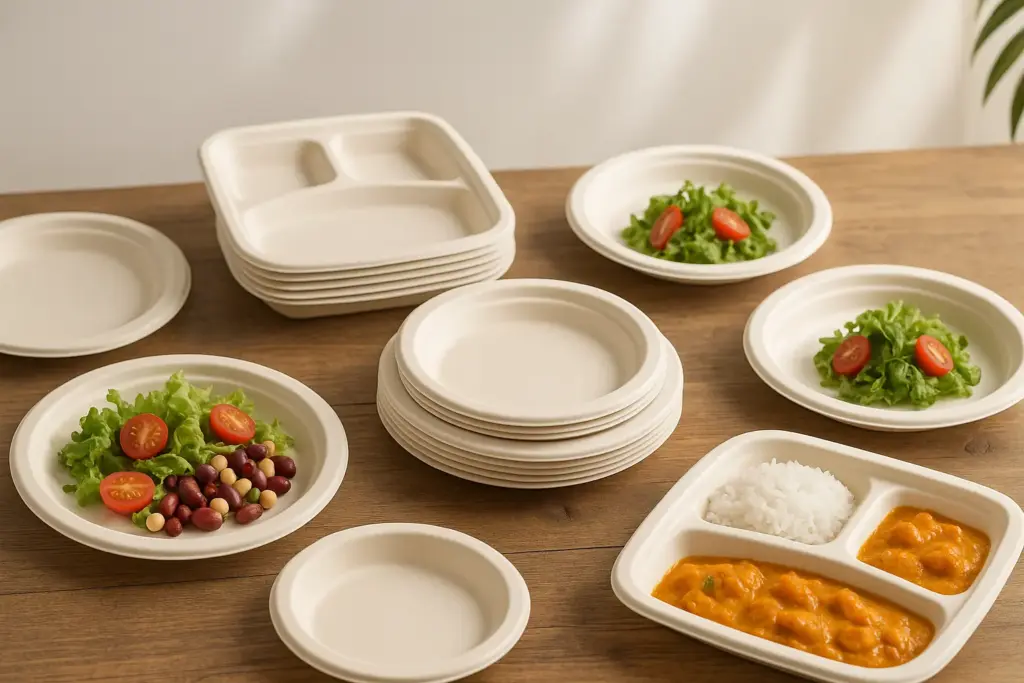
Its plates, bowls, compartment trays and clamshell boxes are made from natural sugarcane fibre, so they are truly compostable rather than merely labelled biodegradable, and they handle hot, oily and gravy food without any plastic lining.
Everything is produced under strict food-safety certifications, including ISO 9001, ISO 14001, ISO 22000 and ISO 45001, along with SGS testing, Sedex and FDA compliance, so the product is both compostable and properly food-grade.
Pulpcraft supplies direct from the factory in bulk at steady wholesale rates, which lets a restaurant, cloud kitchen or event caterer switch to certified compostable serving for a rupee or two per piece and back up their green claims with something real. To get wholesale pricing, certification details and samples for your menu, reach out to the Pulpcraft team.
Frequently Asked Questions
Is biodegradable the same as compostable?
No. Compostable is a tested, certified subset of biodegradable. All compostable items are biodegradable, but most items labelled only biodegradable are not compostable and may never fully break down cleanly.
How long does compostable packaging take to break down?
Usually 90 to 180 days in the right composting conditions. Natural bagasse tableware is faster, at roughly 60 to 90 days, and works in a home compost pit.
Can I recycle a greasy food container?
Usually not. Oil and food residue contaminate the recycling stream, so most food-soiled packaging is rejected and landfilled. Compostable packaging avoids this because the residue is welcome in compost.
What certification should compostable food packaging have in India?
Look for CPCB (Central Pollution Control Board) approval with a registration number and compliance with the IS/ISO 17088 standard. Avoid oxo-degradable plastics, which are banned.
Is bagasse compostable at home?
Yes. Because it is plain plant fibre with no plastic coating, bagasse breaks down in ordinary home composting as well as in industrial facilities, typically within 60 to 90 days.
The Bottom Line
The three words are not interchangeable, and the difference is not academic. Biodegradable is a loose promise that can hide almost anything. Recyclable is a real solution for clean materials but usually a dead end for greasy food boxes.
Compostable, backed by proper certification, is the one that actually turns your food packaging back into soil, which is why it is the standard to look for on anything a meal touches. Natural fibres like bagasse land there without any tricks, and that is what makes them the honest choice.
Want packaging that is truly compostable, not just labelled green? Pulpcraft supplies certified, compostable bagasse plates, bowls, trays and clamshell boxes in bulk, made from sugarcane fibre and safe with hot food. Get in touch for wholesale pricing, certification details and samples that fit your menu.