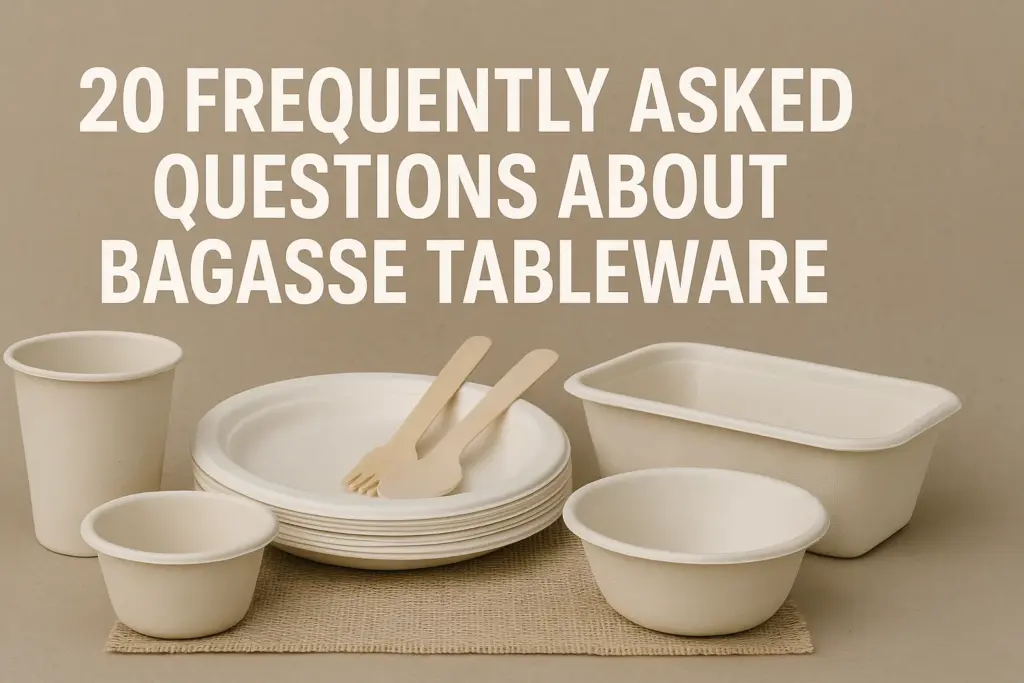
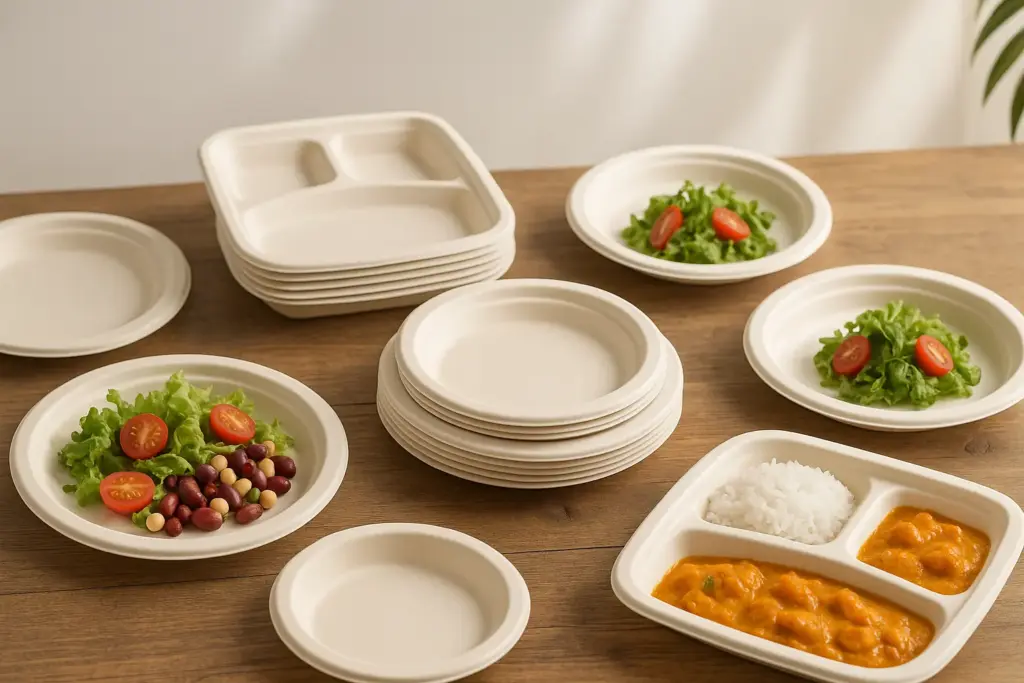
A cloud kitchen has no dining room, so the packaging is the only part of the meal the customer sees before the first bite. If the box leaks or the tray sags, the review blames the food. This guide matches Pulpcraft’s bagasse bowls, trays and plates to common delivery dishes, and explains how to test packaging before you switch.
Table of Contents
Which container suits which dish
Most delivery menus fall into a few formats: rice bowls and biryani, curry with rice or roti, combo thalis, and snacks. Here is what we suggest for each:
| Dish | Container | Why |
|---|---|---|
| Biryani, pulao, fried rice | 360 ml round bowl | Deep enough for a full portion of rice |
| Dal, curry, rajma, chole | 240 ml round bowl | 45.5 mm deep, holds gravy |
| Raita, chutney, dips, desserts | 120 ml kiwi bowl or 180 ml bowl | Small portions, keeps sides separate |
| Thali or combo meal | 5 compartment tray or 3 CP tray | Rice, dal and sabzi stay apart |
| Snack combo (samosa and chutney, idli and sambar) | 2 CP tray | Main item and dip in one tray |
| Momos, pasta, chaat | 6 inch or 7 inch deep plate | 25 mm deep, holds sauce |
| Dine-in or pickup counters | 10 inch round plate | Full meal, eaten on site |
About lids: lidded containers and clamshells are not in Pulpcraft’s listed catalogue. If your delivery format needs a sealed lid, tell us what you need when you ask for a quote and we will tell you what is possible. Many kitchens use bowls and trays for pickup, dine-in and short-distance orders, and seal them with film or a bag for delivery.
Switching your cloud kitchen packaging?
Send your menu and daily order volume. We will suggest a bowl or tray for each dish and send samples so you can run a delivery test.
Bowl, tray and plate specs
These are the items cloud kitchens use most. Every product is pressed from sugarcane bagasse and contains no plastic lining. Read what bagasse tableware is for the background, and our guide to bagasse bowls for bowl sizes.
| Product | Size | Depth | Weight | Per packet | Per box |
|---|---|---|---|---|---|
| 120ml Kiwi Bowl | 80 mm | 35 mm | 4.5 g | on request | on request |
| 180ml Round Bagasse Bowl | 100 mm | 45 mm | 5 g | 50 | 2,000 |
| 240ml Round Bagasse Bowl | 110 mm | 45.5 mm | 6 g | 50 | 2,000 |
| 360ml Round Bagasse Bowl | 140 mm | 40 mm | 9 g | 50 | 2,000 |
| 2 CP Meal Tray | 200 x 130 mm | on request | 8 g | on request | on request |
| 3 CP Meal Tray | 225 x 180 mm | on request | 13 g | on request | on request |
| 5 Compartment Meal Tray | 300 x 245 mm | 34 mm | 35 g | 25 | 500 |
| 6 inch Deep Round Plate | 150 mm | 25 mm | 7 g | 50 | 2,000 |
| 7 inch Deep Round Plate | 175 mm | 25 mm | 8 g | 50 | 1,500 |
| 10 inch Round Plate | 250 mm | 22 mm | 19 g | 25 | 500 |
Why delivery is harder on packaging than dine-in
A delivery order can spend 20 to 40 minutes between the pass and the customer’s door. During that time the container deals with:
- Heat and steam from freshly cooked food
- Oil and gravy pressing on the base and walls
- Stacking inside a delivery bag, with other orders on top
- Tilting and bumps on a two-wheeler
Thin paper softens and leaks under these conditions, and thermocol and plastic carry both regulatory risk under India’s single-use plastic ban and the worry of chemicals leaching into hot food. Bagasse is made of compressed natural fibres that hold their shape under heat and resist oil; our notes on hot and oily food go into detail.
Run a delivery test before you switch
Do not switch a whole menu on a supplier’s word. A simple test with samples tells you what you need to know:
- Pack your heaviest dishes. Take the oiliest curry, the wettest dal and the biggest biryani portion on your menu.
- Wait as long as a real delivery. Leave the packed food for at least 20 to 30 minutes, ideally in a delivery bag.
- Stack and tilt. Put two or three orders on top of each other and tilt the bag the way a rider would.
- Check the base and edges. Look for softening, bending, seepage and oil marks on the outside.
- Reheat one portion. Customers often reheat leftovers. Bagasse is microwave-safe, so test that too.
If a container passes with your worst dish, it will pass with the rest of the menu.
What to check in samples
Beyond the delivery test, look closely at the samples themselves. A good supplier’s product passes all of these:
- Rigidity. A loaded bowl or tray should feel balanced when held with one hand and should not bend at the edges.
- Uniform thickness. Hold two pieces together. They should match in weight and wall thickness.
- Clean moulded edges. No rough rims, cracks or loose fibres where food or a rider’s glove can catch.
- Stacking. Pieces should nest and separate easily without sticking or cracking, which matters at a busy packing station.
- Batch consistency. Ask whether the next order will come from the same plant and specification as the samples.
Packaging cost and the review score
Packaging is a real line item for a cloud kitchen, and our breakdown of cloud kitchen costs shows where it sits against rent, commissions and food. The cheapest container per piece is not always the cheapest per order: a container that fails means a refund, a remake or a one-star review. Strong containers also mean no double-packing, which saves both material and time at the pass.
Running several kitchens or brands
Many cloud kitchen operators run several brands out of one kitchen, or several kitchens across a city. Use the same bowls and trays everywhere so packing stations, storage and reorder quantities stay the same. Our guide to standardising plates across outlets explains how. Store boxes dry and off the floor; see our storage guide.
After the meal: disposal
Bagasse containers are plastic-free and can be composted after use; our composting tips explain how, and a line on your menu card saying so costs nothing.
Buying in bulk
Pulpcraft makes every plate, bowl and tray at its own plant in Kaimur, Bihar. The plant holds BRCGS (Packaging Materials, Grade A), ISO 9001, ISO 14001, ISO 45001 and ISO 22000 certification, with SGS and CIPET test reports on the products. You can see the certificates on the About page. We supply cloud kitchens with bagasse meal trays, bowls and bagasse plates for bulk orders. Box counts are listed in the spec table, and you can read more about buying wholesale.
FAQs
Which bagasse container is best for biryani delivery?
The 360 ml round bowl holds a full portion of biryani or pulao. Pack raita separately in a 120 ml kiwi bowl.
Do bagasse bowls leak with curry?
Bagasse holds hot curry and dal without leaking. Test your own gravy with samples before switching, using the delivery test above.
Do you sell lidded containers or clamshells?
Lidded containers and clamshells are not in our listed catalogue. Tell us your requirement when you contact us and we will tell you what is possible.
Can customers microwave bagasse containers?
Yes. Bagasse bowls and trays can be used to reheat food in a microwave.
What should a cloud kitchen order first?
Start with samples of the 240 ml and 360 ml bowls and one meal tray, test them with your heaviest dishes, then order full boxes of the ones that pass.
How many containers come in a box?
The 180, 240 and 360 ml bowls are packed 2,000 to a box, and the 5 compartment tray 500 to a box. See the spec table for each item, and ask us for counts not listed there.
Order cloud kitchen packaging direct from the factory
Send your menu and monthly volume for a quote, or call us to plan the switch.