There are three ways to buy disposable plates wholesale in India: walk into a wholesale market, order through a distributor, or buy direct from the factory that makes them. Each one suits a different buyer. This guide explains the trade-offs so you can pick the route that matches your volume.
Table of Contents
The three routes at a glance
| Wholesale market | Distributor or stockist | Direct from the factory | |
|---|---|---|---|
| Best for | Small, one-off or urgent buys | Steady local supply in small lots | Large or repeat orders |
| Order size | A few packets upwards | Packets to a few boxes | Full boxes, usually several |
| Same plate every time? | Rarely: stock changes shop to shop | Depends on who the distributor buys from | Yes: one factory, one specification |
| Specs and test reports | Usually not available | Sometimes | Available on request |
| GST invoice | Varies | Usually | Yes |
| Delivery | You collect | Local delivery | Freight to your city |
Route 1: the wholesale market
Markets such as Sadar Bazar in Delhi have rows of shops selling plates, bowls, glasses and other disposable items by the packet and the bundle. If you need plates tomorrow for a single function, a market is hard to beat: you can see the stock, pay and carry it away.
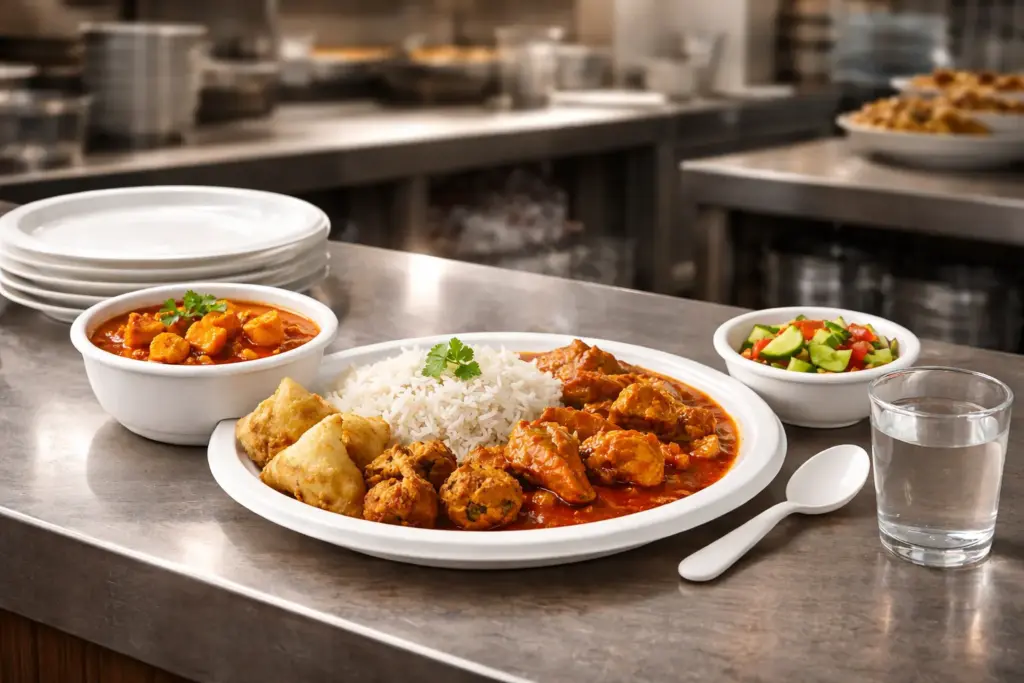
The problems start when you buy the same item twice. Market shops buy from many small manufacturers, so the 10 inch plate you bought last month may come from a different factory this month, with a different thickness and finish. Most of what is on the shelf is paper or plastic-coated paper, and labels rarely tell you the weight, the material or whether the plate is food-grade. For a caterer or restaurant that serves the same menu every day, that inconsistency shows up as soggy plates and complaints.
Route 2: a distributor or stockist
A good local distributor solves the delivery problem. They keep stock near you, deliver small lots and give you credit terms. For a single restaurant or a small catering business this is often the most convenient route.
Ask your distributor which factory the plates come from and whether that changes. If they switch suppliers to chase a lower price, your plates change with them. It is worth asking for the product spec (size, depth, weight) in writing so you can check each delivery against it.
Route 3: direct from the factory
Buying direct makes sense once you are ordering full boxes regularly: caterers, restaurant chains, HORECA businesses, cloud kitchens, retailers stocking their own shelves and distributors themselves. You get one specification every time, the documents a procurement team needs, and you deal with the people who can actually fix a problem.
Pulpcraft makes every plate, bowl and tray at its own plant in Kaimur, Bihar. The plant holds BRCGS (Packaging Materials, Grade A), ISO 9001, ISO 14001, ISO 45001 and ISO 22000 certification, with SGS and CIPET test reports on the products. You can see the certificates on the About page. These are the sizes we make, with the weights and box counts you would be ordering against:
| Product | Size | Depth | Weight | Per packet | Per box |
|---|---|---|---|---|---|
| 6 inch Deep Round Plate | 150 mm | 25 mm | 7 g | 50 | 2,000 |
| 7 inch Deep Round Plate | 175 mm | 25 mm | 8 g | 50 | 1,500 |
| 9 inch Round Plate | 225 mm | 18.5 mm | 14 g | 25 | 1,000 |
| 10 inch Round Plate | 250 mm | 22 mm | 19 g | 25 | 500 |
| 11 inch Round Plate | 278 mm | 24.5 mm | 21 g | 25 | 500 |
| 12 inch Round Plate | 305 mm | 24.5 mm | 25 g | 25 | 500 |
| 10 inch 3 Compartment Plate | 250 mm | 22 mm | 19 g | 25 | 500 |
| 11 inch 4 Compartment Plate | 278 mm | 24.5 mm | 22 g | 25 | 500 |
| 12 inch 4 Compartment Plate | 305 mm | 24.5 mm | 26 g | 25 | 500 |
To work out a monthly order, multiply your daily covers by the number of days you trade, split that across the sizes on your menu, and round up to full boxes. Keep a week of stock as a buffer so a late delivery never forces you back to the market.
Get a factory-direct quote
Send us the sizes you need, rough monthly quantities and your delivery city. We will quote per box including freight, and send samples if you want to test first.
What to check before you place a wholesale order
Whichever route you choose, check these before you commit to volume. Our guide to red flags when buying bagasse plates covers them in more detail.
- Material. Is it bagasse, plain paper, coated paper or plastic? Plastic plates, including thermocol, fall under India’s single-use plastic ban.
- Weight and depth. Two 10 inch plates can differ a lot in weight. Heavier and deeper usually means it carries gravy better. Ask for the figures in writing.
- A real food test. Serve your hottest, oiliest dish on a sample and leave it for 20 minutes. Our notes on hot and oily food explain what to look for.
- Pack and box counts. Know how many pieces are in a packet and a box, so you can compare quotes per piece rather than per bundle.
- Repeatability. Ask whether the next order will be the same plate from the same plant.
- Paperwork. GST invoice, and for larger buyers, food-contact test reports and certificates.
Why bagasse instead of paper or thermocol
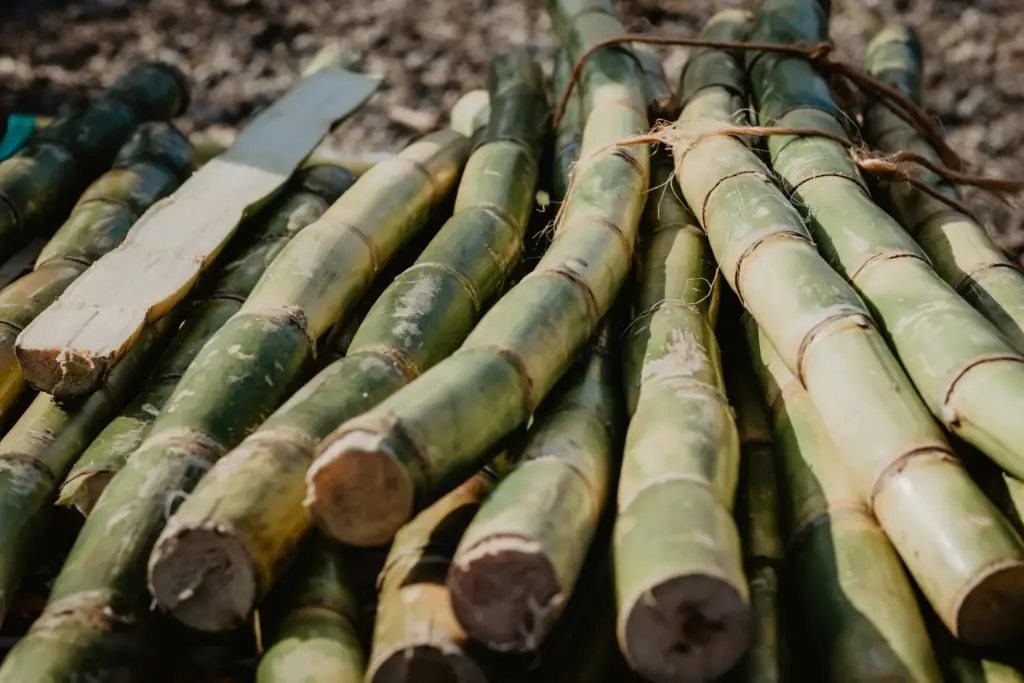
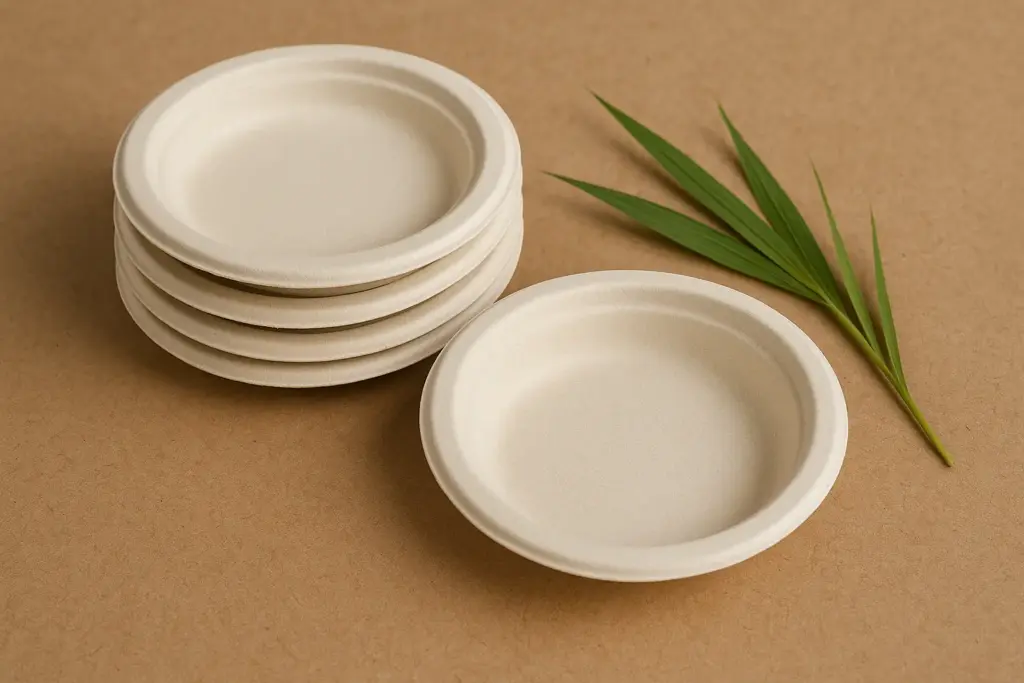
Most of what is sold as cheap disposable plates wholesale is either coated paper or thermocol. Bagasse tableware is moulded from sugarcane fibre, the pulp left after juice is extracted, so there is no plastic layer. It holds hot dal and curry without softening, it is microwave-safe, and it composts after use. Read our guide to sugarcane bagasse tableware for how it is made, and bagasse vs plastic plates for a direct comparison.
It also keeps you clear of the single-use plastic ban. If you put your own brand on packaged products, read our note on EPR compliance as well.
Who buys from us at wholesale volume
- Caterers and event companies ordering for weddings, functions and corporate events.
- Restaurants, QSR chains and cloud kitchens that want the same plate across every outlet. See how to standardise plates across outlets.
- Distributors, stockists and retailers who resell our plates locally.
- Temples, community kitchens and institutional canteens feeding large numbers every day.
- Importers outside India. We export; see our export page and how to import bagasse tableware from India.
Storing a bulk order
Bagasse plates keep well if they stay dry. Store boxes off the floor, away from damp walls and direct sun, and use older stock first. Our guide to shelf life and storage has the details. If you buy a large quantity, spread delivery across the month rather than filling a storeroom you cannot keep dry.
FAQs
What is the minimum order for wholesale disposable plates?
We sell in full boxes. Box counts are in the table above (500 to 2,000 pieces depending on size). Contact us for the current minimum for your sizes and city.
Are factory-direct prices lower than market prices?
For large or repeat orders, buying direct usually removes one or two margins from the chain. For a few packets, a local market or distributor is often more practical. Ask for a quote and compare it per piece.
Can I mix sizes in one wholesale order?
Yes. Most buyers order two or three sizes, for example 12 inch plates for the main course and 6 inch deep plates for snacks.
Do you supply distributors and retailers?
Yes. Tell us your area and expected volumes and we will discuss supply terms.
Do you give a GST invoice?
Yes. Share your GSTIN when you ask for a quote so the invoice is made out correctly.
Can I test the plates before buying in bulk?
Yes. Ask for samples and test them with your own menu before placing a large order.
Buy disposable plates wholesale, direct from the plant
Tell us what you serve and how much you use. We will suggest sizes and send a quote.