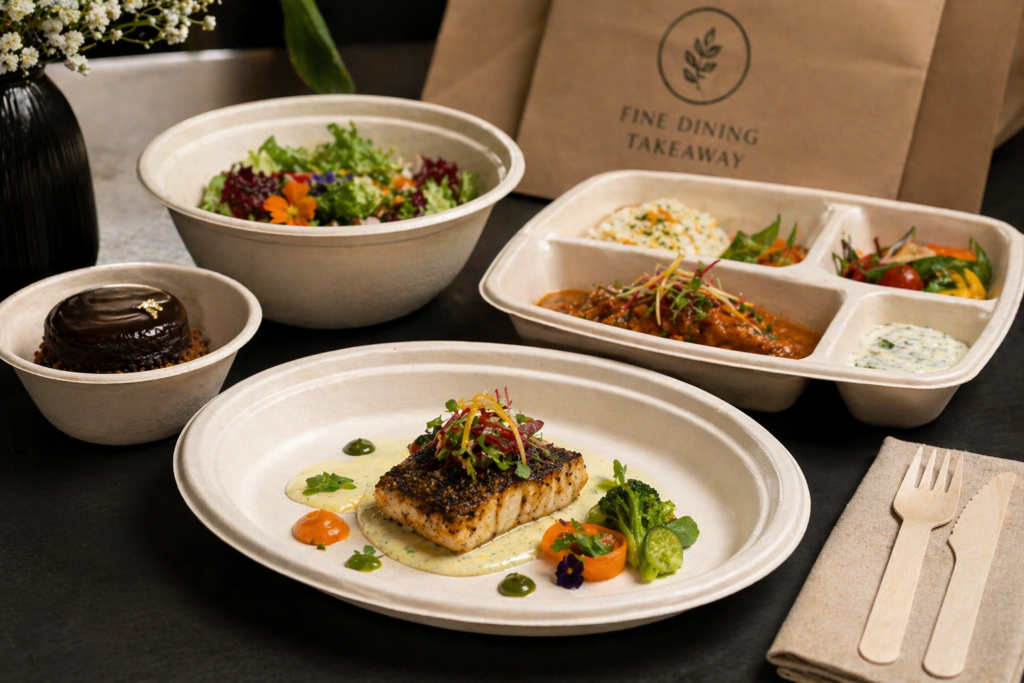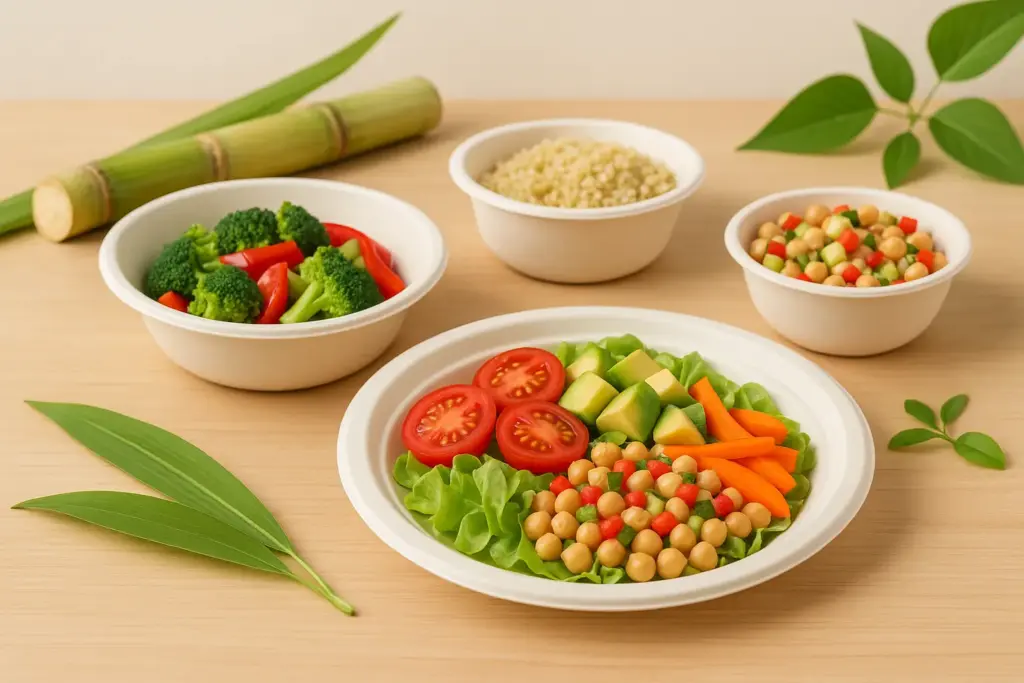
A disposable thali, or compartment plate, keeps dal, sabzi, rice and a sweet in their own sections so nothing runs into anything else. Choosing one comes down to how many dishes you serve and how much gravy is on the menu. This guide covers the three bagasse thali plates Pulpcraft makes and which menu each one suits.
Table of Contents
The compartment plates we make
All three are moulded from sugarcane bagasse, the fibre left after juice is extracted from sugarcane. The dividers are part of the moulding, not glued in, so they do not leak between sections. Sizes are outer diameter.
| Product | Size | Depth | Weight | Per packet | Per box | Best for |
|---|---|---|---|---|---|---|
| 10 inch 3 Compartment Plate | 250 mm | 22 mm | 19 g | 25 | 500 | Everyday thali: rice, dal, one sabzi |
| 11 inch 4 Compartment Plate | 278 mm | 24.5 mm | 22 g | 25 | 500 | Thali with a sweet, raita or salad |
| 12 inch 4 Compartment Plate | 305 mm | 24.5 mm | 26 g | 25 | 500 | Full thali, wedding and festive meals |
Ordering thalis for an event or a kitchen?
Tell us the menu, the number of meals and your city. We will suggest the right plate and quote per box. Samples are available.
3 compartment or 4 compartment?
The 10 inch 3 compartment plate has one large section for rice or rotis and two smaller ones for dal and a sabzi. It is the standard for office canteens, langars, school and college meals and simple lunch service, where the menu is the same three items every day.
The 4 compartment plates add a fourth section for a sweet, raita, salad or pickle. The 11 inch works for a regular thali with four items. The 12 inch gives bigger sections for festive and wedding meals, where portions are generous and guests take puris or rotis on top.
- Two dishes plus rice: 10 inch 3 compartment.
- Three dishes plus rice or roti, or a sweet: 11 inch 4 compartment.
- Large portions, festive menus, weddings: 12 inch 4 compartment.
- Packed meals that travel: a meal tray is easier to stack and carry than a round thali.
Meal trays: the rectangular alternative
If meals are carried from a kitchen to desks or classrooms, rectangular trays fit side by side on a trolley and in carry boxes. We make 2, 3 and 5 compartment bagasse meal trays:
| Product | Size | Depth | Weight | Per packet | Per box |
|---|---|---|---|---|---|
| 2 CP Meal Tray | 200 x 130 mm | on request | 8 g | on request | on request |
| 3 CP Meal Tray | 225 x 180 mm | on request | 13 g | on request | on request |
| 5 Compartment Meal Tray | 300 x 245 mm | 34 mm | 35 g | 25 | 500 |
Bagasse vs silver foil vs plastic thalis
The cheapest thali on a wholesale shelf is usually a plastic-coated paper plate with a silver foil layer, or a moulded plastic thali. Here is how they compare with bagasse for the things a caterer cares about.
| Bagasse | Silver foil paper | Plastic | |
|---|---|---|---|
| Hot dal and gravy | Holds shape, dividers stay firm | Paper base can soften under wet food | Holds, can warp with very hot food |
| Oil | Resists oil | Foil layer resists, edges can soak | Resists |
| Microwave | Yes | No (metal layer) | Depends on the plastic |
| After use | Compostable | Mixed material, hard to compost or recycle | Plastic waste |
| Legal status in India | Allowed | Allowed | Plastic plates are under the single-use plastic ban |
For more on the materials, read bagasse vs paper plates, India’s plastic ban, and our guide to the best disposable plates for Indian food.
What a compartment plate has to survive
A thali is harder on a disposable plate than a flat plate is. The dal sits in a small well for the whole meal, the plate is lifted with one hand while full, and it is often served straight from a hot counter. Check these when you test samples:
- Leaks between sections. Fill the dal section to the top and tilt the plate. Nothing should creep under the divider.
- Softening. Leave hot dal in the plate for 20 to 30 minutes, the length of a slow meal. The base should stay firm. See our notes on hot and oily food.
- Flex when lifted. Pick up a fully loaded plate by one edge. A weak plate folds; a good one stays flat.
- Reheating. If you reheat before serving, check the plate is microwave-safe. Bagasse is.
Planning quantities
One thali per guest per meal, plus about 10 percent spare. For a 400-guest lunch, that is about 440 plates: a little under one box of the 12 inch 4 compartment plate (500 per box). For canteens and community kitchens, multiply daily meals by trading days and order in full boxes.
If some guests are served on flat plates instead, see our page on use and throw plates for flat sizes.
Serving tips for a thali line
- Fill the wettest section last. Rice and rotis first, dry sabzi next, dal or kadhi at the end, so the plate is never carried with a full well of gravy for long.
- Match ladle size to the section. A small section filled with a large ladle overflows onto the rim. One level ladle per section keeps the plate clean.
- Keep stacks dry. Bagasse plates stack tightly. Keep the open packet away from the steam of the serving counter so the top plates stay crisp.
- Put a bin with a liner at the exit. Used bagasse plates and leftover food can go into the same compost bin, which makes clean-up quicker.
Where compartment plates are used
- Weddings and functions with a fixed thali menu.
- Corporate and factory canteens serving the same set lunch every day.
- Langars, bhandaras and temple kitchens feeding hundreds at a sitting.
- Schools, colleges and hostels.
- Takeaway and food courts selling thali combos.
Made from sugarcane, made in our own plant
Bagasse turns a sugar mill by-product into tableware. The chemistry of turning sugarcane waste into plates and our guide to sugarcane bagasse tableware explain the process. After use, the plates go into compost; see our composting tips.
Pulpcraft makes every plate, bowl and tray at its own plant in Kaimur, Bihar. The plant holds BRCGS (Packaging Materials, Grade A), ISO 9001, ISO 14001, ISO 45001 and ISO 22000 certification, with SGS and CIPET test reports on the products. You can see the certificates on the About page. You can browse all our bagasse plates, compare with other eco-friendly plates, or read about why demand for bagasse is growing.
FAQs
What is the difference between a disposable thali and a compartment plate?
They are the same thing. “Thali” is the common Indian name for a round plate with moulded sections.
Which compartment plate is best for a wedding?
The 12 inch 4 compartment plate. It has room for rice, two gravies and a sweet, with space for puris or rotis.
Do the sections leak into each other?
No. The dividers are moulded as part of the plate, so liquid cannot run underneath. Test a sample with your own dal to see for yourself.
How many compartment plates come in a box?
All three sizes come 25 to a packet and 500 to a box.
Do you make 5 or 8 compartment plates?
Our round plates come in 3 and 4 compartment versions. For five sections, use the 5 compartment meal tray.
Can I buy compartment plates wholesale?
Yes. We sell in full boxes direct from the plant. Read our guide to buying disposable plates wholesale or contact us for a quote.
Order disposable thalis in bulk
Send your menu and number of meals for a quote, or ask for samples first.