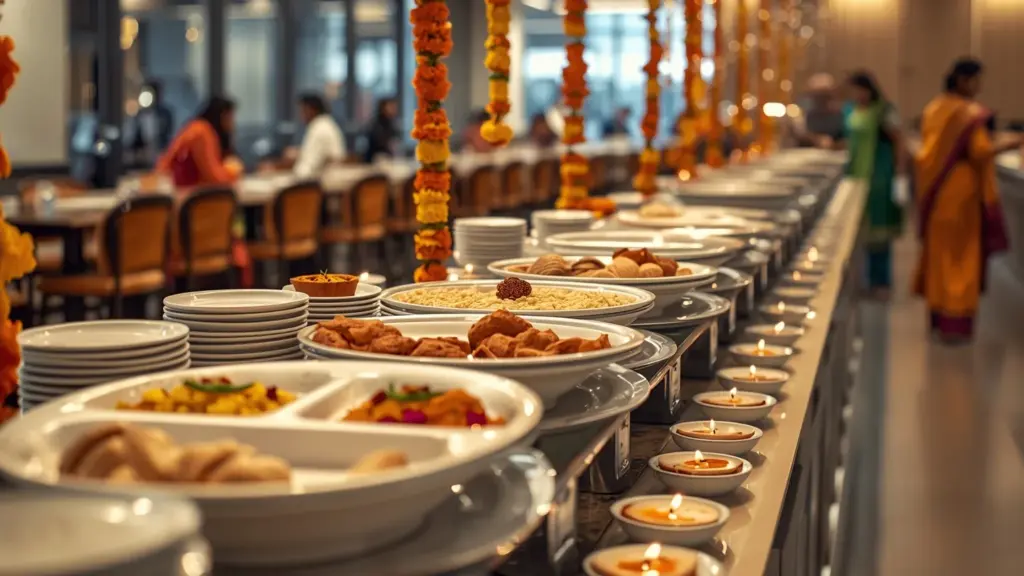
Chaat is the hardest food to serve on a disposable. It is wet, sour, often hot and cold at once, and the customer eats it standing up. A leaf dona that leaks tamarind chutney onto someone’s hand, or a plate that softens before the last papdi, is something they remember. Here is what works for each chaat, for counters, sweet shops and wedding caterers running a live chaat station.
Table of Contents
Why depth and shape matter more than size
Most chaat portions are small, so a big plate is wasted money. What matters is whether the plate can hold liquid. Yoghurt, tamarind chutney, green chutney and ragda all run. A flat plate lets them pool at the rim and drip; a plate or bowl with a raised edge keeps them where they belong.
That is why Pulpcraft’s chaat range is built around three shapes: the 5 inch triangle plate with a raised rim for dry and semi-wet chaat, the 6 inch deep plate (25 mm deep) for chaat with ragda or chhole, and small bowls from 120 to 180 ml for anything that is mostly liquid.
Which plate for which chaat
| Chaat | Best plate or bowl | Why |
|---|---|---|
| Pani puri / golgappa | 120 ml kiwi bowl for the pani, plus a triangle plate for filled puris | Leak-proof bowl, so the pani does not seep out |
| Papdi chaat, sev puri | 5 inch triangle plate | Raised rim holds the yoghurt and chutneys; the shape looks good at a counter |
| Aloo tikki chaat, ragda pattice | 6 inch deep plate | 25 mm depth holds hot ragda or chhole under the tikki |
| Chhole bhature, samosa chaat | 7 inch deep plate | Room for gravy plus a second item |
| Bhel puri, jhal muri | 150 ml square bowl | Easy to hold and eat from with a spoon |
| Dahi bhalla / dahi vada | 180 ml round bowl | Deep enough for the yoghurt to cover the bhallas |
| Raj kachori, basket chaat | 6 inch deep plate | Holds the kachori upright with yoghurt around it |
Running a chaat counter or a live chaat station?
Tell us the items on your menu and your daily or per-event count. We will send samples of the plates and bowls that fit, then quote for the full quantity.
What is wrong with leaf dona, paper and thermocol
- Leaf dona and pattal: traditional and compostable, but stitched leaves let chutney seep through, and quality changes from batch to batch. We compare leaf plates with bagasse in bagasse vs areca leaf plates.
- Paper plates and silver foil plates: uncoated paper goes soft under yoghurt and chutney within minutes, and foil-laminated plates do not compost. See bagasse vs paper plates.
- Thermocol: it does hold liquid, but plastic plates are covered by the single-use plastic ban, and many customers now notice. More in why thermocol tableware should be banned.
- Newspaper: still common for dry chaat and bhel at street stalls, and a real problem for food safety. We explain why in eating food wrapped in newspaper.
Hygiene is the other reason counters switch. Customers watch how chaat is served, and a clean, uniform plate supports the point we made in our piece on Indian street food hygiene. Bagasse is food-grade and has no plastic lining; see is bagasse tableware safe and why takeaway containers can leach chemicals.
Planning quantities for a counter or an event
For a chaat counter: track how many plates of each item you sell on an average day for two weeks, multiply by 30, and add 10 percent. Most counters need two or three plate types, not seven.
For a wedding live counter: assume most guests visit the chaat station once, and many take two items. For 400 guests, plan on roughly 600 small plates or bowls across the items you serve. The triangle plate ships 4,000 to a box and the small bowls 2,000 to a box, so one box of each usually covers a large wedding with stock left for the next function.
If you cater weddings, our wedding catering guide and the 2026-27 shaadi muhurat dates help with planning the season. For home gatherings, see our cricket watch party guide.
Presentation counts at a premium counter
A sweet shop or a café charging more for chaat cannot serve it on a torn dona. The triangle plate and the square bowl look deliberate on a counter and in photos customers post. If you want your packaging to carry your brand, read when packaging shapes your brand, and ask us about custom requirements on bulk orders.
Sizes and box counts
| Product | Size | Depth | Weight | Per packet | Per box |
|---|---|---|---|---|---|
| 5 inch Triangle Plate | 132 x 120 mm | on request | 3.5 g | 50 | 4,000 |
| 6 inch Deep Round Plate | 150 mm | 25 mm | 7 g | 50 | 2,000 |
| 7 inch Deep Round Plate | 175 mm | 25 mm | 8 g | 50 | 1,500 |
| 120ml Kiwi Bowl | 80 mm | 35 mm | 4.5 g | on request | on request |
| 150ml Square Bagasse Bowl | 102 mm | 30 mm | 5 g | 50 | 2,000 |
| 180ml Round Bagasse Bowl | 100 mm | 45 mm | 5 g | 50 | 2,000 |
Pulpcraft makes every plate, bowl and tray at its own plant in Kaimur, Bihar. The plant holds BRCGS (Packaging Materials, Grade A), ISO 9001, ISO 14001, ISO 45001 and ISO 22000 certification, with SGS and CIPET test reports on the products. You can see the certificates on the About page. For larger plates for mains and thalis, see every size on our use and throw plates page.
FAQs
What is the best disposable plate for pani puri?
Use a small leak-proof bowl, like the 120 ml kiwi bowl, for the pani, and a 5 inch triangle plate if you serve filled puris such as dahi puri.
Will bagasse plates go soggy with yoghurt and chutney?
No. Bagasse is moulded under heat and pressure and holds yoghurt, chutney and ragda without softening through a normal serving.
Can I serve hot ragda or chhole on them?
Yes. Use the 6 or 7 inch deep plate, which is 25 mm deep and holds hot gravy.
How many triangle plates are in a box?
The 5 inch triangle plate ships 50 to a packet and 4,000 to a box.
Do you supply chaat chains and sweet shops?
Yes. We supply by the box, with repeat orders on the same specification. Contact us with your monthly usage for a quote.
Can I get samples first?
Yes. Ask for samples so you can test them with your own pani, chutneys and ragda.
Get chaat plates and bowls direct from the factory
Send your menu and quantities for a quote, or call us to talk it through.