Plan the food around the match, not the other way round. When to serve, what people can eat without looking away from the screen, and how to set up a room so twelve people can all see the ball.
The short version
A T20 runs about four hours, and there is exactly one window where people will properly eat: the innings break, roughly 20 minutes long. Everything before and after has to be food you can hold in one hand without looking at it. Plan for that, put the food where people already are rather than at a dining table, and give everyone a plate they can balance on a knee.
Who this is for: anyone hosting eight to fifteen people for an IPL evening game, a World Cup fixture, or a final. Flats, terraces, hostel common rooms, office lounges.
Hosting a match is not hosting a dinner. Guests arrive for the cricket, and they will eat standing, sitting on the floor, or wedged on a sofa arm, all while facing the same direction. The host who plans a sit-down meal for 9 PM ends up serving it cold at 11, because nobody is leaving the screen during a chase. Work with that rather than against it and the evening runs itself.
When do matches actually start, and why does it matter?
Short answer: IPL evening games start at 7:30 PM IST and finish around 11. That is a four-hour window with one real break in the middle, and it decides your whole food plan.
The standard IPL slot is 7:30 PM IST. On double-header days there is an afternoon game at 3:30 PM as well. A T20 innings takes around 90 minutes, the innings break is about 20 minutes, and each innings also has two strategic timeouts of two and a half minutes.
Those numbers matter because they are your serving windows. Twenty minutes is enough to put out a full spread and let people fill a plate. Two and a half minutes is enough to refill a glass. The rest of the time, anything you carry into the room competes with the cricket and loses.
| Phase | Clock, 7:30 PM start | What to serve |
|---|---|---|
| Arrivals and toss | 7:00 to 7:30 | Drinks, nuts, dry namkeen, popcorn |
| First innings powerplay | 7:30 to 8:00 | Nothing new, everyone is watching |
| Middle overs | 8:00 to 8:50 | First hot round: kebabs, pakoras, cutlets |
| Innings break | 8:50 to 9:10 | The main spread, all of it, at once |
| Second innings | 9:10 to 10:20 | Refills, chaat, whatever is left |
| Death overs | 10:20 to 11:00 | Nothing. Nobody is eating |
| After the match | 11:00 onwards | Dessert, chai, leftovers |
The death overs line is the one hosts get wrong. If the game is close, no one will touch food from about the 16th over of the chase. Anything you bring out then goes cold and gets eaten at midnight. Hold it.
What should you serve at a cricket party?
Short answer: Food that works in one hand, needs no cutlery, and survives twenty minutes on a plate without going soggy.
The test for every dish is simple: can someone eat it while looking at a screen? If it needs a knife, two hands, or concentration, it is the wrong dish for the format.
Works well
- Kebabs, tikka and seekh, off the skewer onto a plate
- Pakoras, samosas, cutlets, spring rolls
- Dry manchurian, chilli paneer, honey chilli potato
- Sandwiches and pav, cut into halves rather than quarters
- Chaat served in a bowl: bhel, sev puri, papdi
- Popcorn, roasted makhana, peanuts, chips with dips
- Paneer or chicken tikka rolls, wrapped tight in foil or paper
Works badly
- Anything on the bone that needs both hands
- Curry with rice, which needs a table and full attention
- Dosa, poori, or anything that has to come straight off the flame
- Salads that need a fork
- Soup, in any form
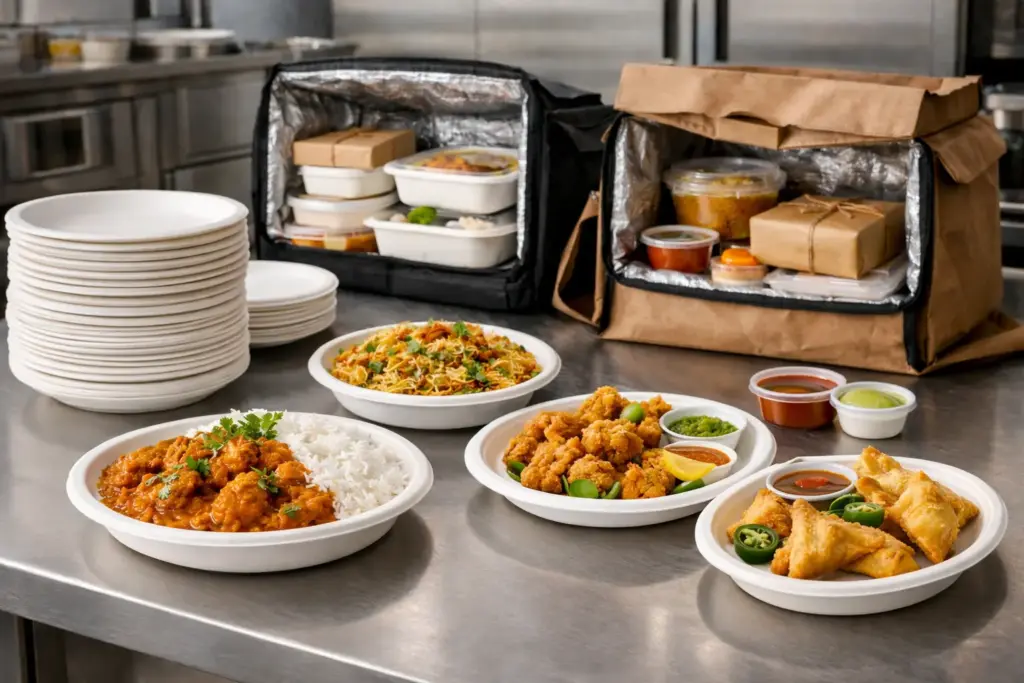
If you want one hot dish that carries the evening, make it something that holds: chole with pav, pulao that people can spoon onto a plate, or a large tray of biryani served at the innings break. All three sit happily for an hour and none of them need cutting. Our guide to the best disposable plates for Indian food covers which formats suit which dishes.
For the innings break specifically, put everything out at once rather than in courses. Twenty minutes does not allow for sequencing, and a queue that moves slowly means people miss the start of the chase and blame the host.
How much food and drink do you need?
Short answer: Six to eight snack pieces per person across the evening, one substantial dish, and about 1.5 litres of drink per head over four hours.
People graze for four hours rather than eating one meal, so the total is higher than a dinner but spread thinner. Working numbers for 12 guests:
| Item | For 12 guests |
|---|---|
| Hot snacks | 80 to 100 pieces total, across 3 or 4 varieties |
| Dry snacks and namkeen | 1.5 to 2 kg |
| One substantial dish | Biryani, pulao or chole with pav, 3 to 4 kg cooked |
| Dips and chutneys | 4 to 5 bowls, refilled once |
| Cold drinks and water | 15 to 18 litres total |
| Tea or coffee, post-match | 12 cups |
| Plates | 30 to 36 |
| Bowls | 24 |
| Cups or glasses | 30 |
| Napkins | Far more than you think |
Two notes on the numbers. Drinks run out before food at a cricket party, especially with the IPL season running March to May, so buy more water and ice than feels sensible. And the plate count is high for the same reason as a potluck: people take a fresh plate at the innings break, and again after the match. Two to three per person is realistic.
How should you set up the room?
Short answer: Sightlines first, food second. Every seat needs a clear view of the screen, and the food should sit where people can reach it without crossing in front of the television.
- Fix the screen position and the seating arc. Work out where twelve people can actually see. Floor cushions in front, sofa behind, dining chairs at the sides.
- Put the food behind the seating, not beside the screen. A table under the television guarantees somebody standing in front of it during a wicket.
- Give every seating cluster a surface. Stools, side tables, a stack of books, anything that holds a plate and a glass. This is the single fix that prevents drinks on the floor.
- Keep drinks and ice at the back of the room, away from the food table, so the two queues do not collide.
- Put a bin in the room itself. Not the kitchen. If the bin is out of sight, plates pile up on the windowsill.
If you are hosting on a terrace with a projector, add two things: a power plan that does not run an extension across a walkway, and a backup for the stream. Live cricket feeds buffer at exactly the wrong moment, and someone in the room will have a phone stream running two balls ahead, which is its own kind of disaster.
What do you serve it all on?
Short answer: Sturdy disposables with compartments and depth, in enough quantity, because nobody is washing up at 11 PM during a super over.
Crockery is the wrong choice here and not for the usual reasons. It is the noise, the breakage, and the fact that a ceramic plate on a lap during a close finish ends up on the floor. A cricket party wants plates that are light, rigid and expendable.
Three features matter for this format:
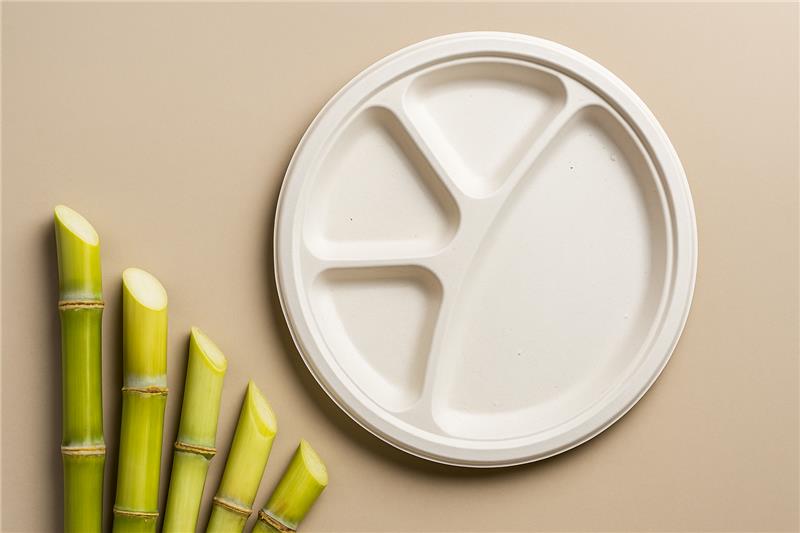
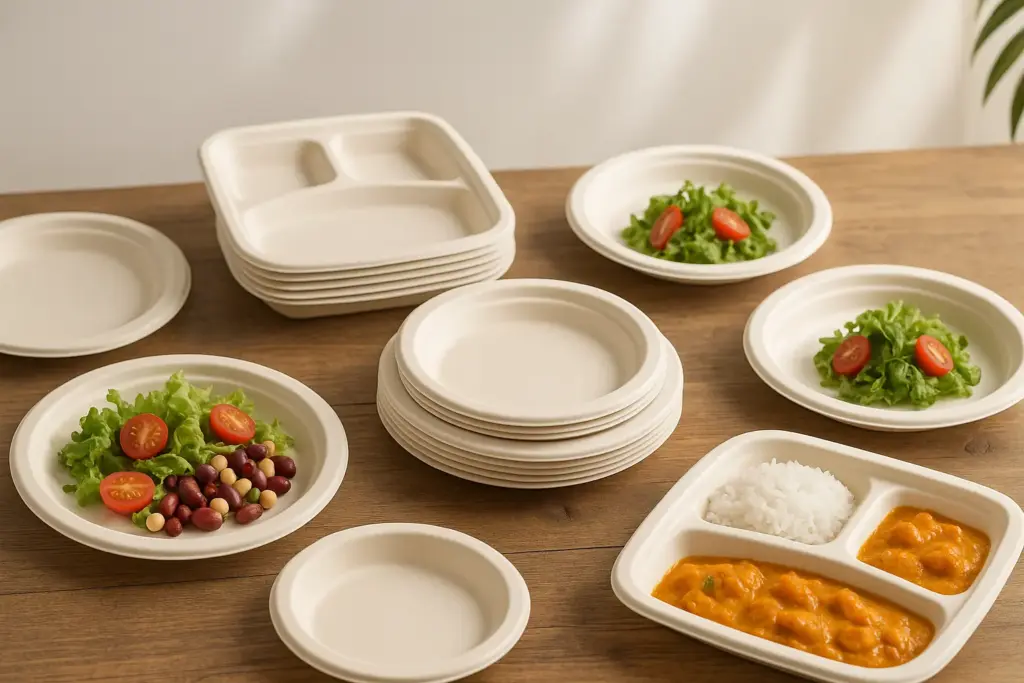
- Compartments. People are eating a mix of dry snack, something saucy and a dip, on their knees. A partitioned plate is what keeps chutney out of the popcorn.
- Depth. Chaat, dips, dry manchurian and ice cream all want a bowl rather than a flat plate.
- Rigidity. A plate held on one hand with no table under it has to not fold. This is where thin plastic and thermocol fail, and they fail while someone is standing.
Thermocol and thin plastic also carry a second problem: several Indian states now restrict single-use plastic cutlery and thermocol, and a party of fifteen generates a bin bag of it in one evening. Moulded sugarcane fibre does the same job without either issue, and we have written separately on why thermocol tableware should be banned outright.
Where Pulpcraft comes in
Short answer: We make the plates, bowls and cutlery this format needs, in bulk packs sized for a house party rather than a restaurant.
Pulpcraft moulds tableware from bagasse, the fibre left after sugarcane is crushed for juice. For a match night, the useful items are the 3-compartment 10 inch and 4-compartment 11 and 12 inch plates, which hold a snack, a dip and something wet without mixing, and the 6 and 7 inch deep round plates and bowls for chaat, dips and dessert. The moulded fibre is dense and carries no plastic lining, so it holds oil and gravy for a full innings instead of going limp.
The plates are microwave and freezer friendly, so leftovers go into the fridge on the same plate and reheat on it the next day. They compost in roughly 30 to 90 days. Our manufacturing carries ISO 9001, ISO 14001, ISO 45001 and ISO 22000 certification along with SGS food safety and Sedex compliance.
If you are hosting through a whole season rather than one game, buying a bulk pack once is cheaper per head than a supermarket run before every fixture, and it removes the 7 PM scramble on the evening of a big match. Ask us for a quote with your usual headcount, or see the guide to biodegradable tableware for events if you are planning something larger.
How do you handle the cleanup?
Short answer: Bins in the room before the toss, and do nothing else until the match ends.
Cleaning during a match is a mistake. You will miss the game and the mess will regenerate. Set up so it manages itself:
- Two bins in the viewing room, labelled. One for wet waste and compostables, plates and bowls included. One for bottles and cans.
- A stack of clean containers in the kitchen, so leftovers go home with people instead of into your fridge.
- Napkins everywhere, on every surface, not in one pile by the food.
- Do the actual clearing after the presentation ceremony, when people are talking about the game and will help without being asked.
Frequently asked questions
What food is best for a cricket watching party?
Anything that eats in one hand with no cutlery: kebabs, pakoras, cutlets, sandwiches, chaat in a bowl, and one substantial dish like biryani or chole with pav served at the innings break.
When should I serve the main food during a match?
At the innings break, which is about 20 minutes in an IPL game. Put everything out at once rather than in courses, because the break is not long enough to sequence anything.
How much food do I need for 12 people at a match party?
Around 80 to 100 hot snack pieces across three or four varieties, 1.5 to 2 kg of dry namkeen, one substantial dish, and 15 to 18 litres of drinks across the four hours.
What time do IPL matches start?
Evening games start at 7:30 PM IST and usually finish around 11 PM. On double-header days there is also an afternoon match at 3:30 PM IST.
How many plates do I need for a cricket party?
Two to three per guest, so 30 to 36 for twelve people. Guests take a fresh plate at the innings break and again after the match.
Should I use crockery or disposables for a match party?
Disposables, for a group above about eight. People eat on their laps with no table, ceramic breaks, and nobody wants to wash up at 11 PM. Sturdy compartment plates in moulded fibre are the practical choice.
The bottom line
Plan the evening around the match clock rather than a mealtime. Serve dry snacks through the first innings, put the full spread out at the innings break, and stop bringing food out once the chase gets tight. Set the room up so every seat sees the screen and every seat has somewhere to put a plate. Get that right and you watch the game instead of running the room.
Hosting through the season? Pulpcraft supplies bagasse plates, bowls, trays and cutlery in bulk across India, sugarcane-fibre tableware that holds hot food on a lap and composts afterwards. Get in touch for wholesale pricing and samples.