A plain-language guide to Extended Producer Responsibility, the rules tightening around plastic packaging, and the simplest way to shrink your burden.
The short version
EPR (Extended Producer Responsibility) makes the business that puts plastic packaging into the market responsible for collecting and recycling it afterwards. In India, producers, importers and brand owners must register on the CPCB portal, hit rising recycling targets, and file every year, or face environmental compensation, import blocks and prosecution.
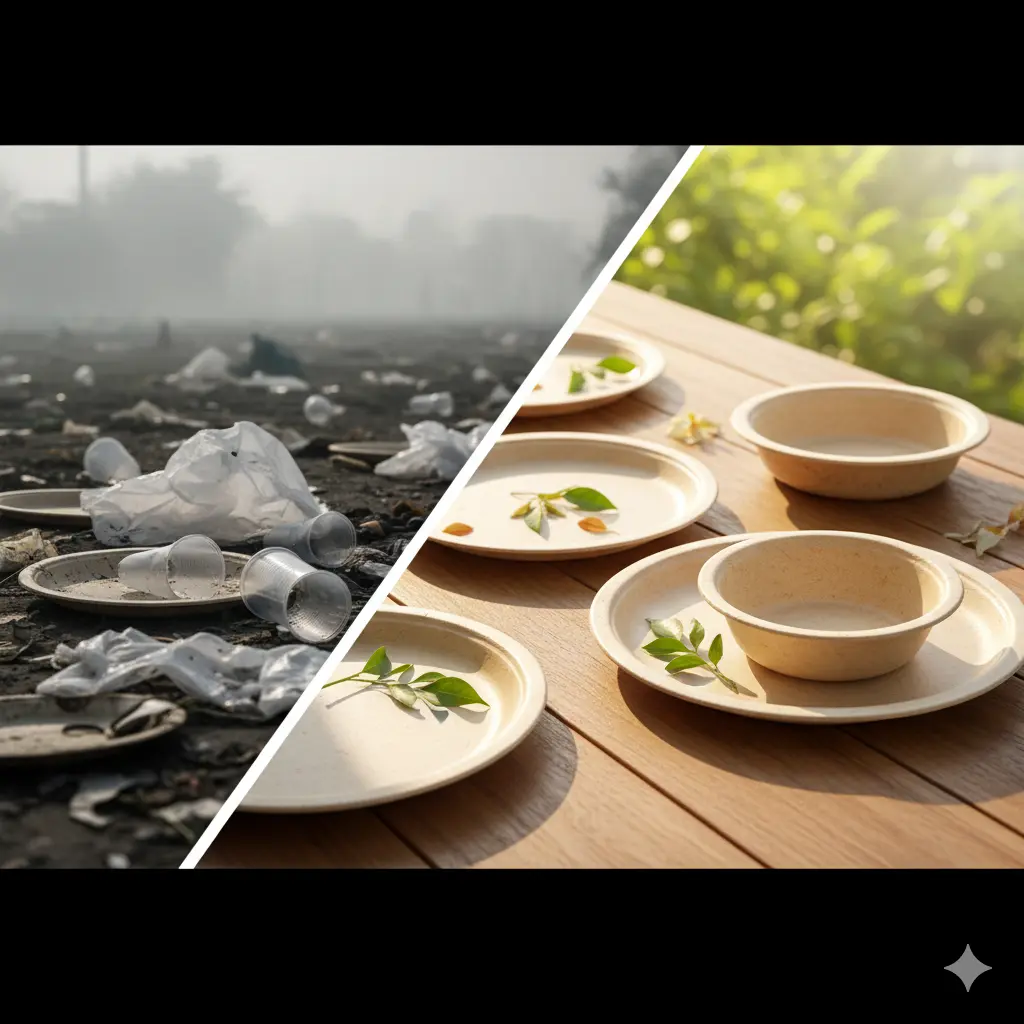
One of the cleanest ways to lighten the load is to use less plastic in the first place. Natural-fibre packaging like bagasse is not a plastic, so it sits outside the plastic packaging that EPR governs.
Who this is for: founders, operations and compliance teams at manufacturers, importers, brand owners, restaurants, cloud kitchens and any business that packs a product in plastic. This is general information, not legal advice.
EPR is one of those three-letter terms that sounds like someone else’s problem until it lands on your desk with a deadline attached. It stands for Extended Producer Responsibility, and in India it now applies to any business that sells a physical product in plastic packaging. The rules are tightening every year, the penalties now have real teeth, and from 2025 they can even hold your imports at customs. This guide explains what EPR is in plain language, who it applies to, what happens if you ignore it, and the simplest way to reduce the burden.
What is EPR, in plain terms?
Short answer: EPR makes the company that puts packaging into the market responsible for what happens to it after the customer is done with it. If you sell it, you help collect and recycle it.
For most of history, a company’s responsibility for its packaging ended at the checkout. After that, the waste became the government’s problem and, ultimately, the landfill’s. Extended Producer Responsibility flips that. It extends your responsibility past the sale and all the way to the end of the packaging’s life. Under India’s Plastic Waste Management Rules and the EPR guidelines introduced in 2022, if your business introduces plastic packaging into the market, you are on the hook for ensuring an equivalent amount is collected and recycled or processed. The idea is simple and fair: the business that profits from the packaging should pay for cleaning it up.
Who has to comply with EPR in India?
Short answer: Producers, importers and brand owners, together called PIBOs. If you manufacture plastic packaging, import goods packed in plastic, or sell products under your own brand in plastic packaging, EPR applies to you.
The rules group obligated businesses under three labels, and most companies fall into at least one:
- Producers who manufacture plastic packaging or plastic raw material.
- Importers who bring in plastic packaging or goods packed in it. Since July 2025, customs clearance can require proof of EPR registration. If you are sourcing from overseas, our guide to importing bagasse tableware from India covers the paperwork side.
- Brand owners who sell products under their own brand in plastic packaging, which sweeps in a huge range of food, retail and consumer businesses.
The packaging itself is sorted into four categories, and your obligations depend on which you use:
| Category | What it covers | Examples |
|---|---|---|
| I | Rigid plastic packaging | PET bottles, HDPE containers, PP caps |
| II | Flexible, single-layer plastic | LDPE pouches, polythene carry bags |
| III | Multi-layered plastic (MLP) | Chip packets, toothpaste tubes, laminated pouches |
| IV | Compostable plastic (bioplastics) | Certified PLA-type packaging; needs IS 17088 certification and separate norms |
What are the EPR rules and targets?
Short answer: You register on the CPCB EPR portal, submit a plan, and then meet annual collection and recycling targets that rise every year, increasingly including a mandate to use recycled content in new packaging.
Once registered, a business has to meet yearly targets for collecting and recycling a set percentage of the plastic it put on the market, and those percentages climb over time. Newer amendments also require a growing share of recycled material inside new packaging. A snapshot of the direction of travel:
| Obligation | Now | Rising to |
|---|---|---|
| Category I collection target | 30% (FY 2025-26) | 60% (FY 2028-29) |
| Category II collection target | 10% (FY 2025-26) | 20% (FY 2028-29) |
| Recycled content in rigid packaging | 5% (FY 2026-27) | 30% (FY 2029-30) |
Businesses meet these targets either by arranging collection and recycling themselves through registered plastic waste processors, or by buying EPR certificates and plastic credits from processors who have surplus capacity. Every year there is a filing to submit, usually by 30 June, and the whole system runs through the CPCB’s online EPR portal. The clear trend is that the targets only get stricter, so the amount of plastic you are accountable for matters more each year.
What happens if you ignore EPR?
Short answer: You face environmental compensation charges for missed targets, your imports can be held at customs, your registration can be suspended, and serious non-compliance can lead to prosecution under the Environment Protection Act.
EPR is no longer a soft, tick-the-box exercise. Missing your targets triggers environmental compensation, a financial penalty tied to the shortfall, though part of it can be refunded if you make up the gap within the carry-forward window. Beyond the money, since July 2025 importers without valid EPR registration can have shipments blocked at customs, which turns a paperwork lapse into a supply-chain emergency. Persistent non-compliance can mean suspension or cancellation of your registration, show-cause notices, and prosecution under the Environment (Protection) Act, which carries the possibility of heavy fines and even imprisonment. For a growing business, the reputational and operational risk is as serious as the fine.
How does switching to compostable or natural-fibre packaging help?
Short answer: EPR obligations apply to plastic packaging. Natural moulded fibre like bagasse is not a plastic, so replacing plastic packaging with it reduces the plastic tonnage you have to register, track and hit targets against.
The entire plastic EPR machinery, the registration, the targets, the certificates, the penalties, is built around plastic packaging. The less plastic you put into the market, the smaller every one of those obligations becomes. Natural-fibre tableware and packaging made from bagasse, the fibre left after sugarcane is crushed, is not a plastic at all. It is plant fibre. So when you replace a plastic clamshell or container with a bagasse one, that packaging falls outside the plastic categories EPR governs, and it stops adding to the plastic tonnage you are accountable for.
Compostable plastic, the bioplastic sold as PLA and similar, is still treated as plastic under EPR. It sits in Category IV and needs IS 17088 certification and its own collection norms. Bagasse is different. It is natural moulded fibre, not a bioplastic, so it does not fall into that category at all. If the labels blur together, our explainer on biodegradable vs compostable vs recyclable untangles them. For a business that wants to genuinely shrink its plastic EPR exposure rather than shift it sideways, natural fibre is the cleaner move.
Where Pulpcraft comes in
If you are a food business, brand owner or caterer looking to cut the plastic you are accountable for, Pulpcraft makes the switch straightforward. It manufactures bagasse plates, bowls, compartment meal trays and clamshell boxes from natural sugarcane fibre that replace plastic directly across serving and takeaway. Because these are plant fibre rather than plastic, every unit you switch is packaging that no longer feeds your plastic EPR load. The products are made under strict food-safety and environmental certifications, including ISO 9001, ISO 14001, ISO 22000 and ISO 45001, along with SGS testing, Sedex and FDA compliance, so they stand up to both food-safety and sustainability scrutiny. Pulpcraft supplies direct from the factory in bulk at steady wholesale rates, so moving off plastic costs only a rupee or two more per piece while easing your compliance paperwork. To see the full product range or get wholesale pricing and samples for your menu, reach out to the Pulpcraft team.
How to get started with EPR compliance
Short answer: Work out which categories of plastic you use, register on the CPCB EPR portal, submit your EPR plan, meet and file your targets, and cut your plastic use to shrink the whole obligation.
- Map your packaging. List every plastic item you produce, import or sell under your brand, and sort it into the four EPR categories.
- Register on the CPCB EPR portal. Use your GST and PAN details, select your categories, upload documents and submit an EPR management plan.
- Meet your targets. Arrange collection and recycling through registered processors, or buy EPR certificates to cover the gap.
- File on time. Submit your annual returns by the deadline, usually 30 June, to avoid environmental compensation and import blocks.
- Reduce plastic at the source. Switch what you can to natural-fibre alternatives like bagasse, so next year’s obligation is smaller to begin with.
Frequently asked questions
Is EPR mandatory for small businesses in India?
If your business puts plastic packaging into the market as a producer, importer or brand owner, EPR registration applies regardless of size. Check the current thresholds and your category on the CPCB EPR portal or with a compliance professional.
Does bagasse packaging need EPR registration?
Bagasse is natural plant fibre, not plastic, so it falls outside the plastic packaging that plastic EPR governs. Any plastic you still use remains covered, but replacing plastic with bagasse reduces that obligation.
Is compostable plastic the same as bagasse for EPR?
No. Compostable plastic, such as PLA, is still treated as plastic under EPR Category IV and needs IS 17088 certification. Bagasse is natural moulded fibre and is not a bioplastic, so it is not in that category.
What is the penalty for not complying with EPR?
Missed targets attract environmental compensation, imports can be blocked at customs without EPR proof, registration can be suspended, and serious cases can lead to prosecution under the Environment Protection Act.
When is the EPR annual filing due?
Annual returns are generally due by 30 June each year, filed through the CPCB EPR portal. Deadlines can be extended by notification, so confirm the current date each year.
The bottom line
EPR is the direction Indian regulation is heading, and the pressure on plastic packaging will keep rising. Every business that sells a physical product needs to understand its obligations, register, and stay on top of its targets and filings, because the penalties now reach from the bank balance to the customs gate. The smartest long-term move is to reduce the plastic you are responsible for in the first place. Swapping plastic packaging for natural-fibre alternatives like bagasse is one of the few decisions that lightens your compliance load and improves your brand at the same time.
Want to shrink your plastic EPR load? Pulpcraft supplies certified bagasse plates, bowls, trays and clamshell boxes in bulk, natural sugarcane-fibre packaging that replaces plastic and sits outside plastic EPR obligations. Get in touch for wholesale pricing and samples that fit your business.
Sources
- Central Pollution Control Board, Extended Producer Responsibility portal for plastic packaging
- Ministry of Environment, Forest and Climate Change, Plastic Waste Management (Amendment) Rules, 2022 – EPR guidelines
- Afleo, EPR plastic waste registration guide for PIBOs (CPCB)
- Gravita India, EPR for plastics: rules, penalties and compliance