Bagasse tableware is made from the fibrous residue of sugarcane processing, turning agricultural waste into functional, compostable foodservice products. This guide covers what bagasse is, how it’s manufactured, how it compares to plastic and paper, and what buyers need to know about certifications, PFAS, and sourcing.
What Bagasse Actually Is (and Isn’t)
Bagasse is the dry, fibrous pulp left over after sugarcane stalks are crushed for juice. For decades, sugar mills either burned it for fuel or threw it away. Neither option was great. Burning contributed to air pollution; landfilling wasted a perfectly useful material.
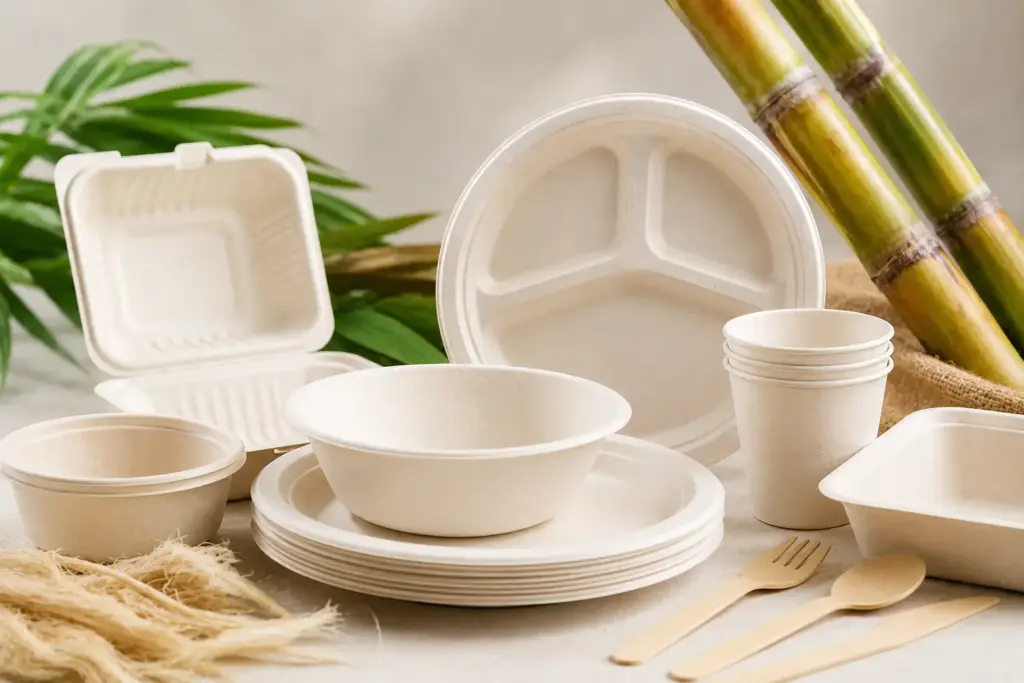
The shift happened when manufacturers figured out that bagasse fibers could be pulped, molded, and pressed into rigid tableware: plates, bowls, clamshell containers, trays, cups. The resulting products look and feel similar to molded paper but hold up significantly better against heat, grease, and moisture.
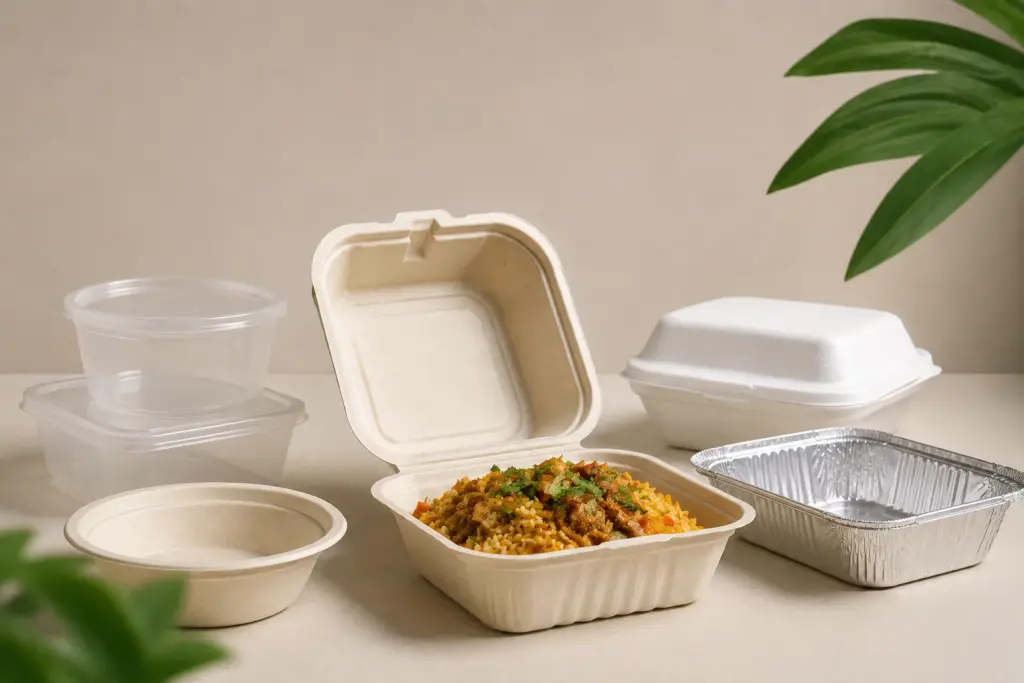
They’re not paper. They’re not plastic. They’re a distinct material category that sits between the two in terms of performance, while outperforming both on environmental metrics.
One number puts the scale in perspective: sugarcane is the world’s largest crop by production quantity, with 1.9 billion tonnes produced in 2020. Every ton of sugarcane yields roughly 280 kg of bagasse. That’s an enormous, annually renewable feedstock that doesn’t require cutting down trees or drilling for petroleum.
How Bagasse Tableware Is Manufactured
The production process is straightforward, though the engineering behind modern molding equipment is more sophisticated than it first appears. Here’s the sequence:
- Collection: Bagasse is gathered from sugar mills after juice extraction. This step alone is what makes the material circular; it repurposes waste that already exists.
- Cleaning and pulping: The raw fiber is washed to remove residual sugar and dirt, then mixed with water to form a slurry. Unlike many paper products, bagasse tableware manufacturing typically doesn’t involve harmful chemicals, making the pulp naturally food-safe.
- Screening: The slurry passes through fine mesh screens to remove inconsistent fiber fragments and impurities. This ensures structural uniformity in the finished product.
- Molding: Pulp is poured into heated molds and pressed under high temperature and pressure. The fibers interlock and solidify into rigid shapes. Manufacturers use either wet-press or dry-press technology; wet-press systems generally produce smoother surfaces and better rigidity.
- Drying and sterilization: Molded items are dried to remove remaining moisture and sterilized for food-safe use.
How Bagasse Compares to Plastic and Paper
Bagasse is often marketed as “better than plastic and paper.” That’s mostly true, but not entirely. Here’s where things actually stand:
Durability and Heat Resistance
Bagasse outperforms paper plates by a wide margin. Paper sags with hot or wet food; bagasse doesn’t. Against plastic, bagasse holds its own for food-safe temperatures but can’t match engineered plastics for extreme applications.
For foodservice use, though, it’s more than adequate. It handles curry, noodles, salads, fried food, and saucy pasta without leaking or softening.
Compostability
This is where bagasse genuinely dominates. Bagasse tableware decomposes in 60 to 90 days under industrial composting conditions. Plastic persists for centuries. Paper’s compostability varies depending on coatings; many paper plates use plastic linings that compromise biodegradability.
Cost
Bagasse costs more per unit than commodity plastic. That gap is narrowing as plastic taxes and single-use bans spread, but it hasn’t closed.
For businesses buying in bulk, the price difference is often offset by lower compliance costs and stronger brand positioning with eco-conscious customers.
Microwave and Freezer Performance
Bagasse is safe for both. Microwave-safe without warping, freezer-friendly without cracking. It maintains its structure under both hot and cold conditions, which gives it a practical edge over polystyrene (not microwave-safe) and uncoated paper (not freezer-stable).
Shelf Life
Stored in a cool, dry place, bagasse tableware lasts one to two years without degrading. It only begins breaking down when exposed to composting conditions: moisture, heat, and microbial activity.
The PFAS Question: Why It Matters for Buyers
PFAS (per- and polyfluoroalkyl substances) are synthetic chemicals historically added to food packaging to improve grease and water resistance. They’re sometimes called “forever chemicals” because they degrade very slowly in the environment and have been linked to water contamination and long-term health concerns.
This matters for bagasse buyers because some manufacturers have used PFAS treatments on molded fiber products. The material itself is clean; the coating is where the problem creeps in.
Regulations are tightening fast. Several U.S. states, including California, New York, Washington, Colorado, and Maine, have introduced restrictions on PFAS in food-contact packaging. European regulators are evaluating broader restrictions. Major retailers and restaurant chains now require PFAS-free declarations and third-party laboratory testing from suppliers.
If you’re sourcing bagasse tableware, verifying PFAS-free status isn’t optional anymore. Request total fluorine testing reports from an accredited lab. Don’t rely on supplier claims alone. And confirm that the test report covers the specific product models you’re purchasing, not just a generic sample from the same factory.
Where Bagasse Tableware Makes Sense
Not every business needs bagasse tableware, and we won’t pretend otherwise. Here’s where it genuinely fits:
- Takeout and food delivery: Clamshell containers with secure lids, grease-resistant bowls, compartment trays. This is the highest-volume application, and it’s where bagasse’s resistance to oil and moisture pays off most directly.
- Catering and events: Weddings, corporate functions, festivals. Bagasse plates look cleaner and more professional than paper, and guests notice. For event organizers, the compostability also simplifies waste management; everything goes in one bin.
- Quick-service restaurants and cafes: Dine-in or to-go, bagasse signals environmental commitment without sacrificing functionality. It’s particularly relevant for brands targeting younger, sustainability-conscious demographics.
- Institutional foodservice: Schools, hospitals, corporate cafeterias. These environments serve high volumes and face increasing pressure, both from regulators and from internal ESG mandates, to reduce plastic waste. Bagasse fits institutional sustainability goals while handling the practical demands of feeding hundreds or thousands daily.
Where it doesn’t fit as well: very high-moisture applications requiring hours of liquid contact (think soup stored overnight), or ultra-low-cost contexts where the per-unit premium over plastic is a dealbreaker. For those cases, other compostable packaging materials may work better.
Certifications That Actually Matter
The certification landscape for compostable packaging is dense. Not all labels carry equal weight. Here are the ones worth verifying:
- BPI Certification (North America): Meets ASTM D6400/D6868 standards for industrial compostability. This is the baseline for selling compostable foodservice products in the U.S. and Canada.
- EN 13432 (Europe): The European standard for compostable packaging in industrial facilities.
- OK Compost HOME/INDUSTRIAL (TÜV Austria): Widely recognized internationally. The HOME variant is stricter, certifying that products break down in lower-temperature home composting conditions.
- FDA Compliance (21 CFR 176.170): Confirms the product is safe for direct food contact under U.S. federal standards.
- PFAS-free declaration: Backed by third-party total fluorine testing. Not a formal certification, but increasingly a hard requirement from retailers.
A product with BPI or EN 13432 certification plus verified PFAS-free status covers the major regulatory bases across North America, Europe, and Australia. Products missing these credentials should raise sourcing questions, regardless of price.
Regulatory and Market Forces Driving Adoption
The shift toward bagasse is being pushed hard by legislation.
The EU Single-Use Plastics Directive bans or restricts many single-use plastic items. The upcoming PPWR (Packaging and Packaging Waste Regulation) will push further toward compostable and recyclable solutions.
In the U.S., California, New York, and Maine are phasing out polystyrene and other single-use plastics. Australia’s national and state-level policies are banning plastic straws, cutlery, and takeaway containers.
The market numbers reflect this momentum. The molded pulp packaging sector is growing at a compound annual growth rate of 7.5%, with food packaging representing about 44.2% of applications. One industry estimate projects bagasse tableware demand surging past $6 billion.
For businesses still on the fence: the regulatory direction is clear. Switching proactively costs less than scrambling to comply after a ban takes effect.
FAQ
Is bagasse tableware safe for food contact?
Yes. High-quality bagasse products are food-grade certified and free from BPA and PFAS. Look for FDA compliance and relevant compostability certifications to confirm safety.
How long does bagasse take to decompose?
Under industrial composting conditions, 60 to 90 days is typical. Home composting takes longer, especially for thicker items, but the material still breaks down without leaving toxic residues.
Can bagasse plates handle hot and greasy food?
They can. Bagasse is heat-resistant, microwave-safe, and naturally resists oil penetration. It won’t become soggy like paper plates when holding hot or greasy food.
How does bagasse compare to plastic on cost?
Per-unit cost is higher than commodity plastic, but the gap is shrinking as plastic taxes, bans, and compliance costs rise. At scale, higher initial costs are offset by lower regulatory risks and brand benefits.
Does bagasse tableware need a plastic lining to hold liquids?
No. Modern molding processes ensure leak resistance without plastic coatings. This is one of the more persistent myths about the material, and it’s outdated.
Sourcing Considerations
Choosing the right supplier matters as much as choosing the right material. A few practical points from reviewing the current market:
Don’t choose suppliers based solely on pricing. Extremely low pricing may indicate weak compliance systems, limited testing capability, or inconsistent production quality. The cheapest bagasse product that fails a PFAS test or arrives with structural defects costs far more than a slightly premium alternative that performs reliably.
Request samples before committing to volume orders. Test them with your actual menu items. A plate that handles a dry sandwich perfectly might underperform with a saucy entree. Real-world testing beats spec sheets.
Verify that your supplier’s certifications are current, cover the specific products you’re ordering, and come from recognized bodies. Expired certifications, or certifications that apply to different product lines, are a common sourcing mistake that can create compliance exposure down the line.
For businesses making their first move into sustainable food packaging, bagasse is one of the most proven, scalable, and well-supported options available. The material science is mature, the supply chain is global, and the regulatory tailwinds aren’t slowing down.