Where the savings actually come from, what still eats your margin, and the one line item you fully control.
What Is a Cloud Kitchen?
A cloud kitchen, also called a dark kitchen, is a restaurant with no dining room. There are no waiters, no fancy fit-out and no prime high-street address.
Food is cooked in a compact kitchen and sent straight out for delivery through Swiggy, Zomato or the kitchen’s own app. Strip away the dining room and a lot of cost goes with it.
The trick is knowing which costs really fall, which ones do not, and where an operator can still move the needle. The numbers below tell that story.
Why the Model Is Cheaper to Run
Most of the savings come down to real estate and people. A dine-in restaurant needs a big space in a location people want to visit, plus a full front-of-house team. A dark kitchen needs a small, cheaper unit tucked away from the main road and a lean crew.
Here is how the two models compare in India:
| Cost line | Dine-in restaurant | Cloud / dark kitchen |
| Setup investment | ₹50 lakh to ₹1 crore | ₹5 to ₹20 lakh (less on a shared model) |
| Monthly rent | ₹1 to ₹3 lakh | ₹30,000 to ₹80,000 |
| Space needed | 1,000 sq ft and up | 150 to 600 sq ft |
| Staff | 8 to 12 people, ₹3 to ₹5 lakh payroll | 2 to 5 people, ₹1 to ₹2 lakh payroll |
| Time to break even | 18 to 36 months | 6 to 12 months |
| Typical net margin | 5 to 15% | 15 to 25% |
The headline is simple. A cloud kitchen usually:
- Needs around a tenth of the capital a full restaurant does
- Opens in a fraction of the space
- Runs on a smaller team
- Reaches break even two to three times faster
That is why so many food brands now launch delivery-first and only add a dining room later, if at all.
Multiple Brands from One Kitchen
There is a second saving that is easy to miss. Because the kitchen is delivery-only, one physical unit can run several brands at once — say a biryani label, a healthy-bowl label and a dessert label — all out of the same stoves.
The rent and the core team are shared across all of them, so each new brand costs very little to add. A dine-in restaurant can only ever be one restaurant.
The Costs That Do Not Disappear
Cutting the dining room does not make a kitchen a money machine. The savings on rent and staff are handed straight to a new landlord: the delivery platforms. This is the part most first-time operators underestimate.
Where a Single Order Goes
It is worth seeing exactly where a single order goes:
| Where a ₹500 order goes | Amount | Notes |
| Platform commission (about 22%) | ₹110 | Swiggy and Zomato charge roughly 18 to 30% depending on city and deal. |
| GST on the commission | ₹20 | 18% is added on top of the commission, so 22% costs closer to 26% in practice. |
| Packaging | ₹18 | Around 5 to 8% of the order, and one of the few costs the kitchen fully controls. |
| Food and raw materials (about 32%) | ₹160 | Usually the single largest line, at 30 to 35% of revenue. |
| Left for rent, staff, utilities and profit | ₹192 | Everything else has to come out of this, which is why volume and control matter. |
Aggregator commissions run from about 18 to 30% of the order value, and the 18% GST charged on that commission pushes the real cost higher still. Add food at 30 to 35%, packaging at 5 to 8%, and marketing spend on discounts to stay visible in the app, and the margin gets thin quickly.
On a busy month pushing ₹4 lakh through the aggregators, a kitchen can hand over ₹60,000 to ₹1,20,000 in commission before it pays a single bill of its own.
Fighting Back on Two Fronts
This is why the strong operators fight on two fronts:
- They push volume so fixed costs get spread thin.
- They build their own ordering channel, through a website, an app or WhatsApp, where they keep 95 to 96 paise of every rupee instead of handing over a quarter of it.
Shifting even a third of orders to direct channels can pull the blended commission down from the mid-twenties to around 12 to 15%.
The One Line Item You Fully Control
Look again at that order breakdown. Commission is set by the platform. GST is set by the government. Food cost has a floor, because customers can taste it when you cut corners.
Packaging is the one meaningful cost the kitchen decides on its own, and at 5 to 8% of the order it is far from trivial. It is also the part of the order the customer physically holds, opens and remembers.
Get it wrong and a leaked curry or a soggy box turns into a one-star review, which on a delivery app costs real money.
Why Plastic and Thermocol Are on the Way Out
For a long time the default was plastic and thermocol, chosen because they were cheap. That logic is running out. State after state is banning single-use plastic and thermocol, so a kitchen built on them is one rule change away from scrambling for a replacement.
Customers, especially the higher-spending ones a kitchen most wants to keep, increasingly notice what their food arrives in. Packaging has quietly turned from a pure cost into part of the brand.
Why Bagasse Is the Sensible Upgrade
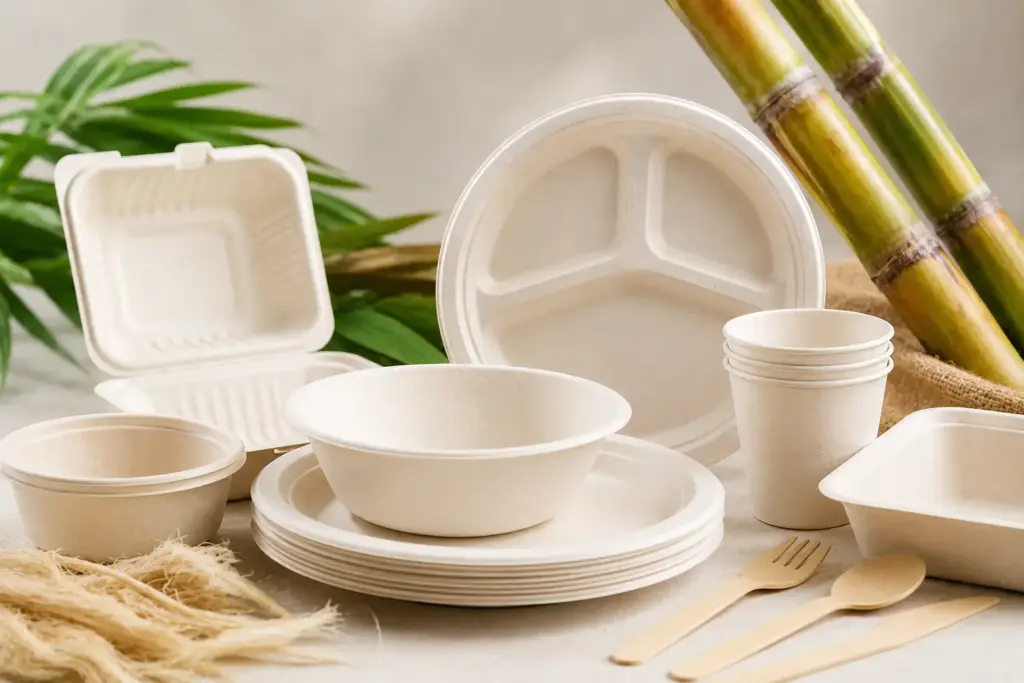
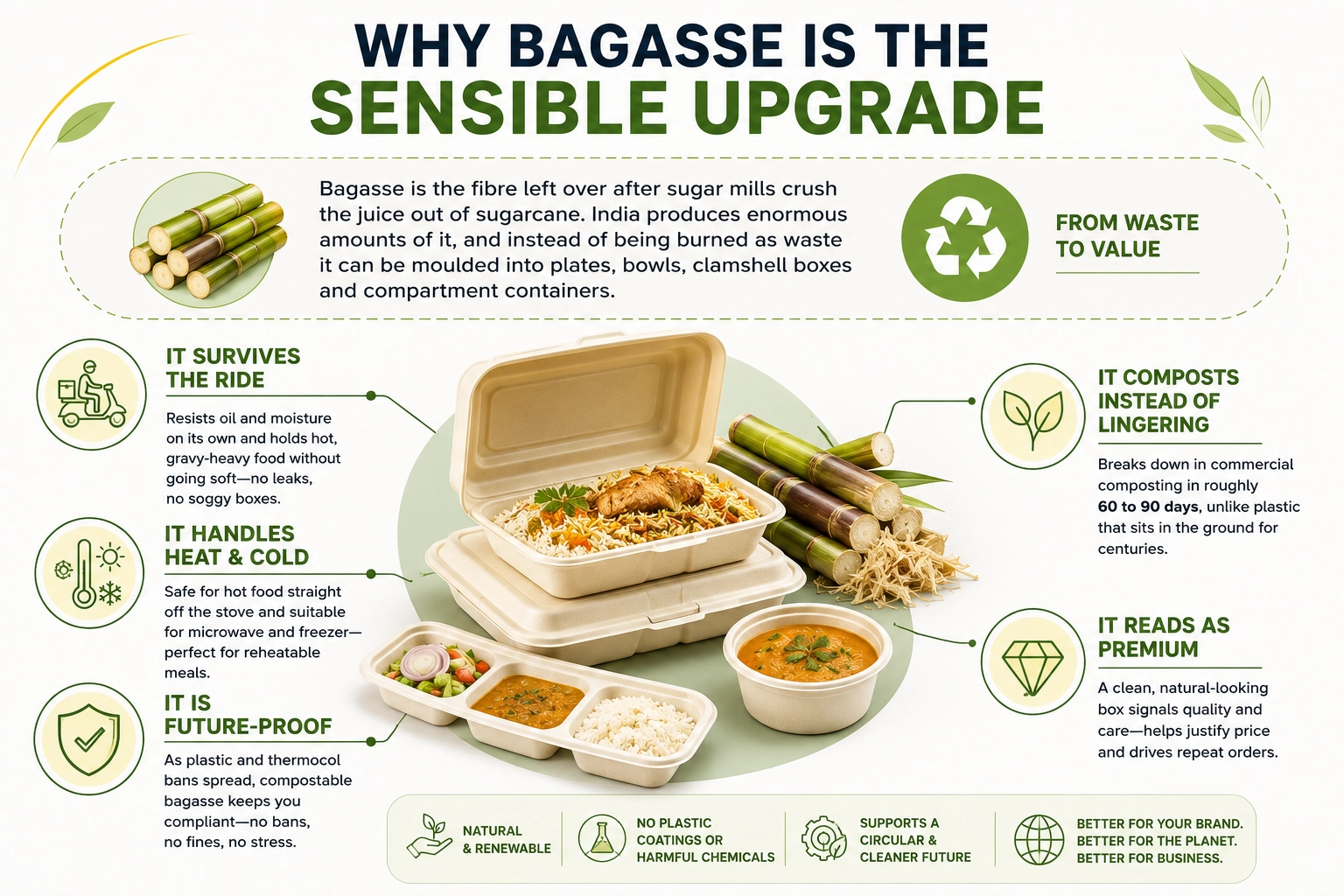
Bagasse is the fibre left over after sugar mills crush the juice out of sugarcane. India produces enormous amounts of it, and instead of being burned as waste it can be moulded into plates, bowls, clamshell boxes and compartment containers.
For a delivery kitchen it ticks the boxes that plastic never could:
- It survives the ride. Good bagasse resists oil and moisture on its own and holds hot, gravy-heavy food without going soft, so biryani and curry arrive intact rather than leaking into the bag.
- It handles heat and cold. Containers take hot food straight off the stove and go into a microwave or freezer at the customer’s end, which matters for reheatable meals.
- It is future-proof. As plastic and thermocol bans spread, a kitchen already on compostable packaging has nothing to change and no fine to worry about.
- It composts instead of lingering. Bagasse breaks down in commercial composting in roughly 60 to 90 days, unlike plastic that sits in the ground for centuries.
- It reads as premium. A clean, natural-looking box signals quality and care, which helps justify price and pulls in repeat orders.
Where Pulpcraft Fits In
This is the gap Pulpcraft is built for. As one of the larger bagasse tableware and packaging manufacturers in India, it makes the formats a delivery kitchen actually uses every day, including clamshell boxes, burger boxes, compartment meal trays, bowls and plates.
The containers come with tight snap lids for spill-free transport, resist oil and moisture, take hot and cold food, and stack neatly so packing is fast during a dinner rush.
Certifications and Supply Reliability
For a business, the certifications matter as much as the product. Pulpcraft’s packaging is made under food-grade and food-safety standards including ISO 9001, ISO 14001, ISO 22000 and ISO 45001, along with SGS testing, Sedex and FDA compliance, so it is safe for hot food and stands up to any audit.
As a manufacturer selling direct, it supplies in bulk at steady wholesale rates with reliable availability, exactly what a kitchen doing hundreds of orders a day needs so it never runs short mid-service.
Cost Comparison: Bagasse vs Plastic
On cost, the honest picture is that bagasse sits a little above the cheapest plastic and roughly in line with decent-quality disposables, and the gap narrows at bulk volume.
Since packaging is only 5 to 8% of the order, the move usually adds a rupee or two per meal, while removing the risk of a plastic ban, cutting leak complaints, and giving the brand a genuine sustainability story to put on the box. For most kitchens that is a small price for a lot of upside.
Making the Switch Without Hurting Margins
Changing packaging does not have to be an all-or-nothing decision. A practical order of moves:
- Fix the leak-prone items first. Move curries, biryanis and gravy dishes to leak-resistant bagasse containers, since those are where bad packaging costs you reviews.
- Right-size every container. Match the box to the portion so you stop paying for oversized packaging and food does not slide around in transit.
- Buy in bulk on a schedule. Lock in wholesale pricing and a steady supply so unit cost drops and you are never caught short during a rush.
- Put the switch on the label. A short line such as compostable packaging, made from sugarcane on the box or the app listing turns a cost into marketing.
- Push direct orders alongside it. Every order you move off the aggregators saves far more than packaging ever costs, so the two changes fund each other.
The Bottom Line
Cloud kitchens cut cost in a very specific way. They strip out the rent, the space and the front-of-house staff that dine-in restaurants carry, which is how they open for a tenth of the money and reach profit far sooner.
What they do not escape is the platform commission, the GST on it, and the cost of the food itself. Inside that math, packaging stands out as the one real lever the operator controls.
The smart move is to spend those few percent on something that protects the food, survives a plastic ban, and makes the brand look better rather than worse. Bagasse does all three, and Pulpcraft supplies it at the scale a busy kitchen runs at.
Running a cloud kitchen or a delivery brand? Pulpcraft supplies certified, leak-resistant, compostable bagasse clamshells, meal trays and bowls in bulk, the packaging that keeps your food intact and your brand plastic-free. Get in touch for wholesale pricing and samples, and pick the sizes that fit your menu.