Two days after Diwali this year, homes and temples across India build a small mountain of food for Krishna. When Govardhan Puja falls in 2026, the story behind it, the full 56-dish chappan bhog list, and how to serve Annakut prasad to a few hundred devotees without a heap of plastic plates.
The short version
Govardhan Puja and Annakut fall on Tuesday, 10 November 2026 in India. Drik Panchang gives the morning muhurat in New Delhi as 6:40 am to 8:50 am. Many calendars in the US, UK and UAE mark it a day earlier, on Monday 9 November. Devotees offer Krishna a “mountain of food”, which is what Annakut means, traditionally 56 dishes known as chappan bhog, and then share it as prasad. If you are serving that prasad to a crowd, plan the plates by dish: kadhi and sabzi need a compartment plate or a bowl, and sweets go on something small.
Table of Contents
When is Govardhan Puja in 2026?
Short answer: Tuesday, 10 November 2026 in India, on Kartik Shukla Pratipada. Diwali is on Sunday 8 November, so this year there is a one-day gap between the two.
| Festival | Date in 2026 |
|---|---|
| Dhanteras | Friday, 6 November |
| Diwali (Lakshmi Puja) | Sunday, 8 November |
| Govardhan Puja and Annakut (India) | Tuesday, 10 November |
| Govardhan Puja (many US, UK and UAE calendars) | Monday, 9 November |
The day is fixed by which tithi is running at sunrise. In 2026 the Pratipada tithi holds at sunrise in India on the 10th, which is why Govardhan Puja does not fall the day after Diwali this time. Abroad, local sunrise comes hours later, so several diaspora calendars land on the 9th. If you go to a temple, follow its calendar.
Why is Govardhan Puja celebrated?
Short answer: To remember Krishna lifting Govardhan hill to shelter the people and cattle of Braj from seven days of storms sent by Indra.
The story comes from the Bhagavata Purana. The cowherds of Braj used to prepare a large offering for Indra, god of rain, every year. The young Krishna asked them why they worshipped a distant god when Govardhan hill was the one that fed their cows and gave them water. They made the offering to the hill instead. Indra answered with seven days of torrential rain. Krishna lifted Govardhan on the little finger of his left hand and held it up like an umbrella while the whole village and its cattle sheltered underneath. When the rain stopped, Indra accepted defeat, and the people of Braj cooked a feast for Krishna. That feast is the Annakut.
What is Annakut?
Short answer: Annakut means “mountain of food” (anna is food, kut is a heap or peak). Devotees cook dozens of dishes, arrange them in tiers in the shape of a hill in front of Krishna, and later share them as prasad.
At home, families shape a small Govardhan from cow dung or clay, decorate it with flowers and walk around it in parikrama before the food is offered. In Braj households the meal usually includes Annakut ki sabzi, a slow-cooked mix of every seasonal vegetable in the kitchen, with kadhi, puri and bajra khichdi.
Temples take it much further. The Pushtimarg haveli at Nathdwara is known for its Annakut, and BAPS Swaminarayan temples treat it as one of the biggest festivals of the year. The record for the largest Annakut belongs to BAPS Atladra Mandir in Gujarat, which offered more than 3,500 vegetarian dishes on 27 October 2019.
Chappan bhog list: the 56 dishes
Short answer: There is no single fixed list. Each sampradaya (Pushtimarg, ISKCON, Swaminarayan and others) and many individual temples keep their own. The number 56 is the constant. The list below is a common one, grouped in the order dishes are usually placed: milk preparations and sweets nearest the deity, then breads and savouries, rice, dal, vegetables, and finally fruit and paan.
| Group | Dishes | Count |
|---|---|---|
| Milk preparations | Makhan mishri, dahi, ghee, malai, shrikhand, chaas, lassi, rabri | 8 |
| Sweets | Kheer, rasgulla, gulab jamun, malpua, jalebi, moong dal halwa, mohanbhog (sooji halwa), besan ladoo, boondi ladoo, peda, kalakand, barfi, ghevar, shakkarpara, murabba, khurma | 16 |
| Breads and savouries | Puri, kachori, mathri, papad, pakora, namakpara, sev, bada, baati, cheela, dhokla, bajra roti | 12 |
| Rice and grains | Plain bhaat, pulao, bajra khichdi, dahi bhaat, kesar bhaat, daliya | 6 |
| Dal and kadhi | Moong dal, arhar dal, panchmel dal, kadhi | 4 |
| Vegetables | Annakut ki sabzi, aloo sabzi, saag, baingan bharta, lauki, kaddu (pumpkin) | 6 |
| Accompaniments | Chutney, achaar, fresh fruit, paan with elaichi | 4 |
Everything on the list is sattvik: no onion, no garlic, no meat or eggs, and many households also skip ingredients they consider tamasic, such as mushrooms. If cooking 56 dishes is not realistic, cook fewer. Plenty of families offer a smaller set and count variations (three kinds of ladoo, two kinds of dal) toward the total.
Why are there 56 dishes in chappan bhog?
Short answer: The most widely told reason is arithmetic. Krishna is said to have eaten eight meals a day, and he went without food for the seven days he held up Govardhan. Eight meals for seven days makes 56, so the people of Braj made up every missed meal at once.
A second explanation comes from Ayurveda, which counts six tastes: sweet, sour, salty, bitter, pungent and astringent. Combined, they are said to give 56 kinds of dish, so chappan bhog stands for every kind of food there is.
How to do Annakut at home
- Make the Govardhan. Shape a small hill from cow dung or clay in the courtyard or on a large tray, add a figure of Krishna and a few cows, and decorate it with flowers and small diyas.
- Cook sattvik food in the morning. Use fresh, seasonal ingredients and no onion or garlic. Annakut ki sabzi, kadhi, puri, a rice dish and two or three sweets make a good core.
- Arrange the food as a mountain. Put milk preparations and sweets closest to Krishna, then breads and savouries, rice and dal, and vegetables, with fruit and flowers at the base.
- Offer, pray and do parikrama. Place a tulsi leaf on each dish, perform aarti, and walk around the Govardhan while singing bhajans.
- Share the prasad. Serve it to family first, then neighbours, the cows of the area if you can, and anyone in need.
Serving Annakut prasad to a crowd
Short answer: Temples, housing societies and bhandara committees serving a few hundred to a few thousand devotees need plates that hold kadhi and sabzi without leaking, arrive in uniform cartons, and can go into wet waste afterwards. Plastic and thermocol now fail on that last point and, in many places, on the law as well.
India’s single-use plastic ban has prohibited plastic plates, cups, cutlery and trays since July 2022, and temple authorities are tightening it further. Odisha’s State Pollution Control Board has told temples to enforce the ban, naming thermocol plates, cups and cutlery as common festival items. In August 2025, Andhra Pradesh ordered over 120 major temples to stop the use of disposable plastic plates, cups and bottles on their premises. In Delhi, Gurdwara Bangla Sahib replaced the roughly 5,000 polybags and polystyrene cups and plates it was using each day for prasad with jute bags and leaf bowls back in 2019.
Which plate for which prasad
| What you are serving | What works best |
|---|---|
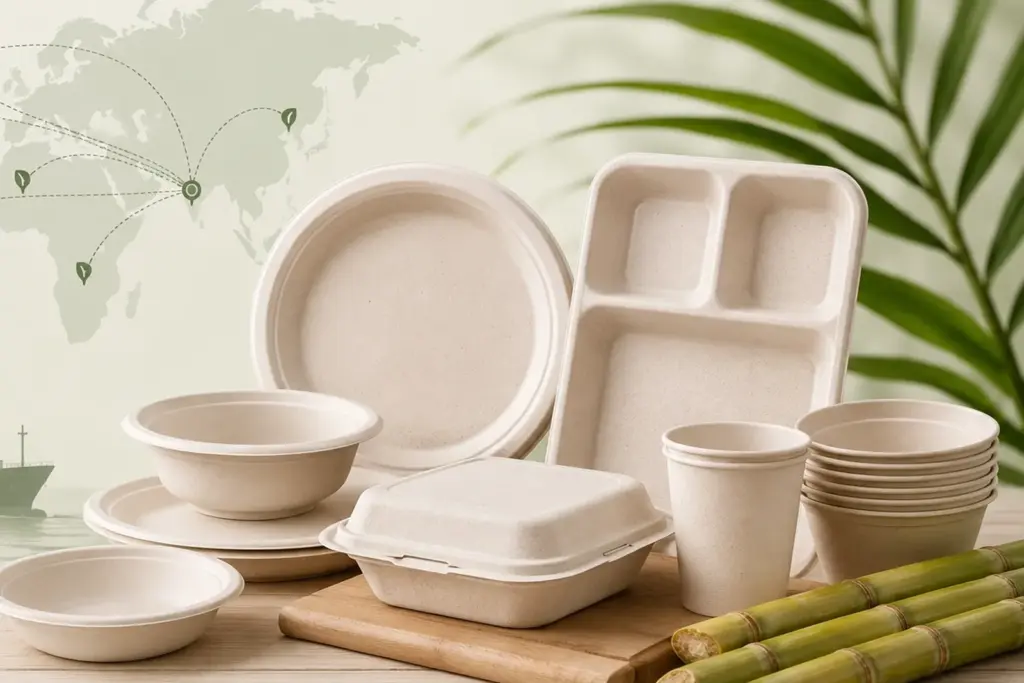
| A full Annakut plate: sabzi, puri, kadhi-chawal and a sweet | 12-inch 4-compartment plate or 11-inch 4-compartment plate, so the kadhi stays out of the puri |
| Kadhi, dal or kheer served on its own | 180 ml or 240 ml round bowl |
| A lighter plate of sabzi and puri | 10-inch 3-compartment plate |
| Sweet prasad at the exit: ladoo, peda, panjiri | 5-inch triangle plate or the 120 ml Kiwi bowl |
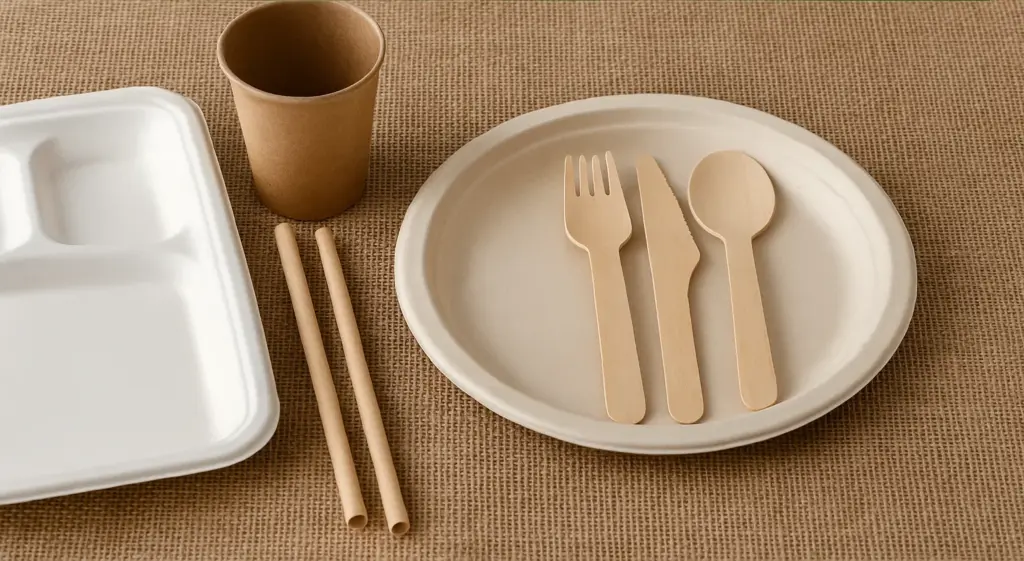
| Prasad packed for elderly devotees or for home | 3-compartment meal tray or a bagasse clamshell box |
Leaf pattals, bagasse or plastic?
If your temple already uses sal or banana leaf pattals and they work for you, keep using them. They are traditional, cheap where they grow, and compost easily. They struggle in two situations: thin, hot kadhi and dal, which find the gaps between stitched leaves, and large orders where every plate needs to be the same size and arrive on a fixed date. That is where bagasse fits. Our comparison of bagasse and areca leaf plates goes into more detail.
| Leaf pattal | Bagasse | Plastic or thermocol | |
|---|---|---|---|
| Hot, runny gravy | Can leak at the stitching | Holds without going soggy | Holds, but hot food on plastic and foam raises leaching concerns |
| Size and supply for 1,000+ plates | Varies by season and supplier | Uniform sizes, made to order | Easy to buy |
| After use | Composts | Composts in about 60 to 90 days | Lasts for centuries |
| Legal status | Allowed | Allowed | Banned under India’s 2022 single-use plastic rules |
| Cost | Lowest where locally made | More than thermocol | Cheapest per piece |
How much to order
For a sit-down Annakut or bhandara, plan one compartment plate, one bowl, one small plate for the sweet and one spoon per devotee, then add about 15% for repeat servings and spills. A temple expecting 1,000 devotees should order about 1,150 of each. If prasad is handed out at the exit rather than served as a meal, small plates or Kiwi bowls alone are enough.
Where to buy bagasse plates in bulk for Govardhan Puja and bhandaras
Pulpcraft makes bagasse plates, compartment plates, bowls, meal trays and clamshell boxes in India and supplies temples, trusts, housing societies and caterers direct from the factory at wholesale rates. Production is certified to ISO 9001, ISO 14001, ISO 22000 and ISO 45001, with SGS testing, Sedex membership and a BRCGS Packaging Materials certificate (Grade A), so what devotees eat from is food-grade.
Tell us how many devotees you expect and what you are serving, and we will recommend a mix and quote for it. Contact the Pulpcraft team for bulk pricing or samples, or see the full range. With Govardhan Puja on 10 November, aim to confirm your order by the end of October.
Frequently asked questions
When is Govardhan Puja in 2026?
Govardhan Puja and Annakut fall on Tuesday, 10 November 2026 in India. Many calendars in the US, UK and UAE mark it on Monday, 9 November. Check your local panchang for the muhurat.
What is the difference between Govardhan Puja and Annakut?
They are celebrated on the same day. Govardhan Puja is the worship of Govardhan hill and Krishna, while Annakut is the “mountain of food” offered to him as part of that worship.
What are the 56 items in chappan bhog?
Lists vary by temple, but they cover milk preparations like makhan mishri and rabri, sweets like kheer, ladoo and jalebi, breads like puri and kachori, rice, dal, kadhi, seasonal vegetables, chutney, fruit and paan.
Can onion and garlic be used in Annakut food?
No. Annakut food is sattvik, so it is cooked without onion, garlic, meat or eggs. Most households use fresh seasonal vegetables and pure ghee.
Which plates are best for serving bhandara or Annakut prasad?
Compartment plates keep kadhi and sabzi separate from puri and sweets. Bagasse plates hold hot, runny food without leaking and compost after use, while plastic and thermocol plates are banned under India’s single-use plastic rules.
The bottom line
Govardhan Puja falls on 10 November this year. At home, a smaller offering made with care counts as much as 56 dishes. If you are feeding a crowd, sort the plates and bowls by the end of October so they are stacked and ready before the first pot goes on the stove.
Serving prasad this Annakut? Pulpcraft supplies certified, compostable bagasse plates, bowls and meal trays in bulk to temples, trusts and societies. Get in touch for wholesale pricing or samples.