And the question behind every meal that almost nobody asks: what are those kids eating off of?
Every school day in India, cooks serve hot rice, dal and vegetables to about 120 million children across more than a million classrooms and courtyards. It is the biggest school-feeding programme in the world, and for many of these children it is the best meal they will eat all day.
What almost nobody stops to ask is a simpler question. What is the food actually served on? The plate matters more than people assume, both for hygiene and for the amount of waste the programme leaves behind.
A programme built to feed a nation’s future
Origins and scope
India’s mid-day meal scheme started on 15 August 1995 as the National Programme of Nutritional Support to Primary Education. In September 2021 it was relaunched and widened as PM POSHAN (Pradhan Mantri Poshan Shakti Nirman), and it now covers children from pre-primary up to Class 8 in government and government-aided schools.
Somewhere between 118 and 120 million children eat through it every day, across roughly 1.1 million schools. No other school-feeding programme in the world comes close in size.
Scale of daily operations
The daily operation is huge. More than 2.5 million cooks and helpers prepare the food, either in the school’s own kitchen or in large central kitchens run by non-profit groups.
For 2024-25, the central government budgeted about ₹12,467 crore, close to US$1.5 billion, and the states add their own share on top. The nutrition targets are spelled out. Primary-grade children should get at least 450 calories and 12 grams of protein per meal, and upper-primary children 700 calories and 20 grams.
Benefits beyond nutrition
The benefits reach well past nutrition. A guaranteed hot meal brings children into school and keeps them coming back, lifts attendance among the poorest families, and helps break down old social divisions around who eats alongside whom. It remains one of the most effective public programmes the country runs.
The blind spot: what 120 million meals are served on
Run anything at this scale and the ordinary serving plate turns into an environmental and public-health decision repeated hundreds of millions of times. Even so, tableware rarely comes up when people talk about the scheme. Visit schools around the country and you find a mix of solutions, each with its own drawbacks.
| Tableware | Where it’s used | The catch |
| Stainless-steel thali | The default in most government schools. Central-kitchen models such as Akshaya Patra also serve on steel. | Reusable and durable, but only as clean as the water and labour behind it. |
| Plastic or melamine plates | Budget government schools and some private-school canteens. | Cheap, but scratches trap bacteria and hot, oily food can leach chemicals. Not compostable. |
| Leaf and areca plates | Traditional, rural, and festival meals. | Natural and single-use, but supply is seasonal, sizes vary, and they can leak with gravy-heavy meals. |
| Thermocol and plastic disposables | Special days, annual functions, and events at both government and private schools. | Convenient but non-biodegradable. Thermocol is now banned in many states and lingers for centuries. |
| Bagasse (sugarcane) tableware | A growing choice for institutions that want single-use hygiene without the plastic. | Compostable in 60 to 90 days, heat and oil resistant, no washing needed. Costs a little more per piece than plastic. |
The problem with steel thalis in practice
The steel thali does most of the work in this system, and on paper it is the greenest choice there is. You buy it once and use it for years. The trouble is that steel is only as safe as the washing behind it, and that is exactly where things fall apart.
During 2025 and early 2026, photos spread online of schoolchildren in Karnataka and Madhya Pradesh washing their own mid-day-meal plates next to open drains, and the public reaction was angry. Across much of rural India, clean water, soap and staff time are all in short supply, and in those conditions a reused plate can quietly start spreading illness instead of standing for good sense.
The disposable problem on special days
At the other end are the disposables that come out for special days, sports events and annual functions. These are usually thermocol or plastic plates, handy on the day and then left to sit in the ground for centuries. Several states have banned thermocol, yet it still turns up at school events because there is no obvious replacement in front of people.
Private schools tend to use plastic or melamine trays in their canteens and order disposables in bulk for functions, usually without a thought for where any of it goes afterwards.
So the real choice is not steel against disposable. It is this: when a single-use plate really is the sensible option, say a school with no reliable water, a festival meal, a sports day or a busy canteen, does it have to be plastic? More and more, the answer is no.
Enter bagasse: a plate made from what used to be waste
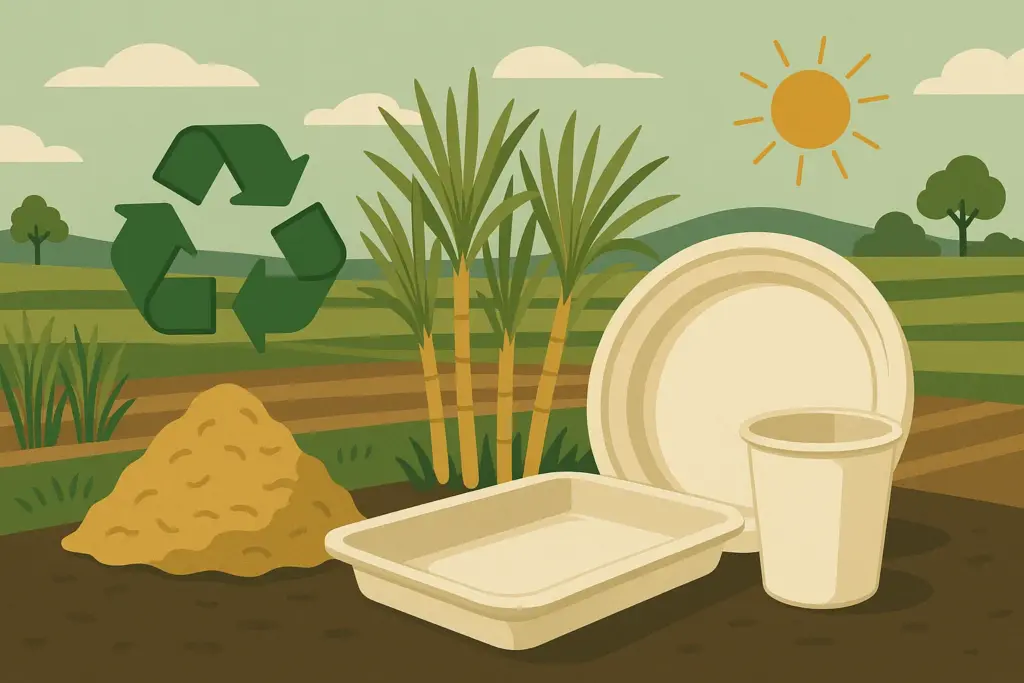
India is the second-largest producer of sugarcane in the world. Once the juice has been crushed out of the stalk, what is left is a fibrous pulp called bagasse. For a long time it was either burned as cheap fuel or thrown away.
Mould that same fibre into plates, bowls and trays and you get single-use tableware made entirely from a farm by-product, with no trees cut down and no plastic involved.
Why bagasse works for schools
What makes bagasse a good fit for schools is not only the environmental story. The plates also hold up in practice:
- Compostable in 60 to 90 days. In composting conditions the plates break down into soil within two to three months. Plastic and thermocol take centuries.
- No plastic lining. Bagasse handles oil and moisture on its own, so it does not need the plastic coating that makes most paper plates impossible to recycle.
- Made for hot, oily, gravy-heavy food. Good bagasse, around 200 to 300 GSM, stays stiff under dal, sambar and rice, and copes with heat up to about 120°C. It is microwave and freezer safe as well.
- Cleaner to serve. A fresh plate for each child removes the washing step, which means no shared water, no scrubbing by a drain and no cross-contamination.
- Safe for food. It is plant fibre with no chemical coating, so there is nothing to leach into a child’s meal.
Where Pulpcraft fits in
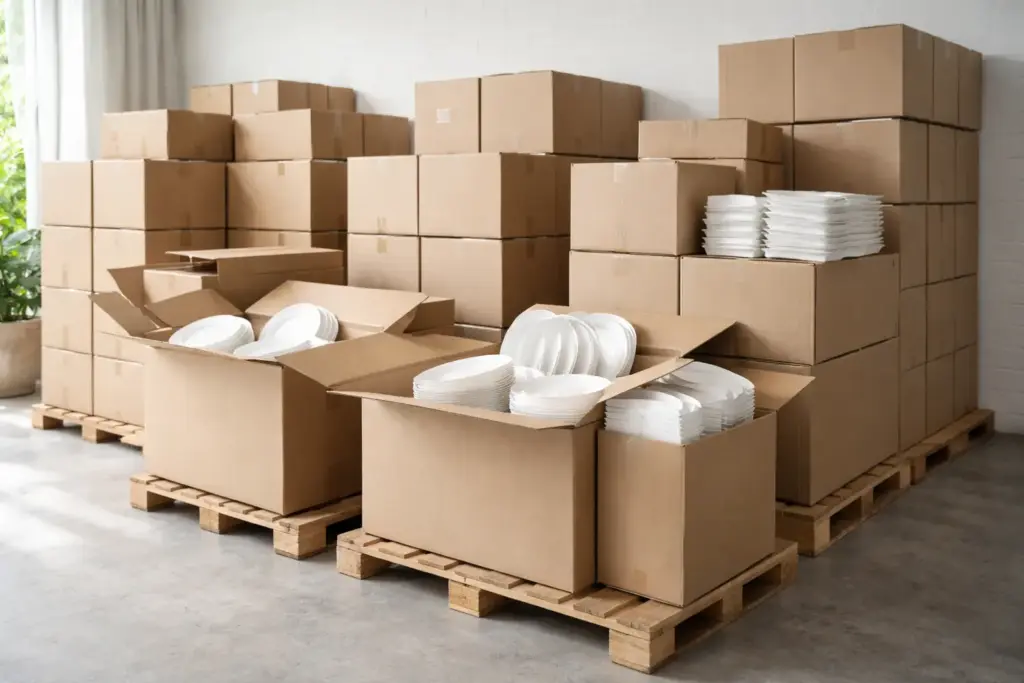
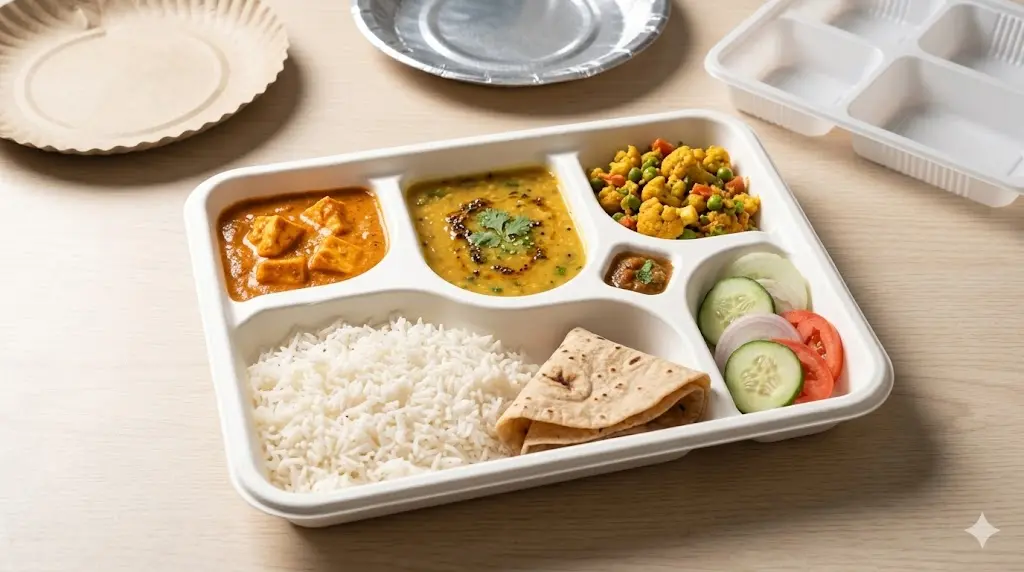
This is the gap Pulpcraft works in. As one of the larger bagasse tableware manufacturers in India, Pulpcraft turns sugarcane fibre into plates, bowls and, most usefully for a meal programme, compartment meal trays.
These trays copy the layout of the sectioned steel thali children already know, with rice in one section, dal in another and sabzi in a third, and nothing running together.
Certifications and institutional readiness
For an institution, the paperwork matters as much as the product. Pulpcraft makes its tableware under a set of quality and food-safety certifications, including ISO 9001, ISO 14001, ISO 22000 and ISO 45001, along with SGS food-safety testing, Sedex and FDA compliance.
That is the sort of documentation a school district or a procurement officer wants to see before serving anything to children. The company supplies in bulk and wholesale quantities, which is the scale a school system or catering partner needs.
The honest trade-off: pricing
The honest trade-off is price. Bagasse plates usually cost between ₹1.80 and ₹5 a piece depending on size and order volume. That is more than a plain plastic plate, and less than most people guess, and the gap shrinks a good deal at bulk volumes.
Weigh it against the water, labour, breakage and hygiene risk of reusable plates in poorly resourced schools, and against the environmental cost of plastic, and the numbers read very differently.
How government schools can make the switch
Nobody is proposing that 120 million steel thalis be thrown out tomorrow. Where a school has clean water and can wash plates properly, reusable steel is still the greenest option. The opening is to replace plastic and thermocol with compostable bagasse in the places where single-use already happens, and to give water-short schools a safer alternative.
A workable path looks like this:
- Start with the pain points. Give priority to schools with unreliable water, and to events such as sports days, annual functions and festival meals, where disposables are already the norm.
- Put it into procurement. Add compostable bagasse tableware as an approved category in PM POSHAN and state tenders, with the ISO and FDA certifications set as the minimum bar.
- Pay for it through CSR and convergence. Corporate CSR budgets and cleanliness or waste-management schemes are a natural fit for covering the small per-plate premium.
- Run a district pilot. Try bagasse trays in one block for a term, track hygiene complaints, water saved and teacher time freed, then scale up on the results.
- Close the loop with composting. Since used plates are compostable, a school with a garden or compost pit can turn leftover food and plates into manure, which doubles as a lesson in how a circular economy works.
How private schools can lead
Private schools can move faster, and many have parents who actively want greener choices. For them it is mostly a buying decision. Swap canteen plastic and event disposables for bagasse trays and bowls bought wholesale, and make the change visible.
A plastic-free canteen and a compost bin are the kind of concrete sustainability story that lands well with students and parents. One annual function served on compostable tableware keeps hundreds of plastic plates out of a landfill and turns a routine event into something children can learn from.
The bigger plate
India feeds 120 million schoolchildren every single day, which is a real achievement by any measure. The next step is to think not only about what goes on the plate, but about what the plate is made of and what happens to it afterwards.
Replacing plastic and thermocol with compostable sugarcane tableware, in the places where single-use cannot be avoided, is a small change per meal that adds up to a very large one across a whole country. It protects children’s health, keeps a lot of plastic out of the soil, and closes a loop that begins and ends in a farmer’s field.
Serving food to a school, a canteen or an event? Pulpcraft supplies certified, compostable bagasse plates, bowls and compartment meal trays in bulk, the plastic-free way to serve at scale. Get in touch for wholesale pricing and samples, and see how your next meal can leave nothing behind but good nutrition.