Bagasse Tableware: What It Is and Why It Matters in 2025
Bagasse tableware is rapidly replacing plastic and Styrofoam across restaurants, catering operations, and corporate dining facilities worldwide. Made from the fibrous residue left after sugarcane juice extraction, this material transforms agricultural waste into sturdy, compostable plates, bowls, clamshells, and trays. With over 280 million metric tons of sugarcane bagasse produced globally each year, the raw material supply is massive and entirely renewable.
The shift isn’t just environmental idealism. Single-use plastic bans now span the European Union, 10 U.S. states, Canada, and Australia. Businesses that haven’t transitioned to sustainable alternatives face regulatory penalties, lost contracts, and reputational damage. Bagasse tableware solves these problems while matching or exceeding the performance of conventional disposables.
This guide covers everything procurement managers, restaurant owners, and sustainability officers need to know: material science, manufacturing steps, product categories, real-world performance data, cost considerations, and sourcing strategies.
What Is Bagasse and How Does It Become Tableware?
Bagasse is the dry, fibrous material that remains after sugarcane stalks are crushed to extract juice. It contains 40% to 50% cellulose, along with hemicellulose and lignin. These natural polymers give bagasse its structural strength and flexibility. Before the tableware industry recognized its potential, sugar mills either burned bagasse for energy or simply discarded it.
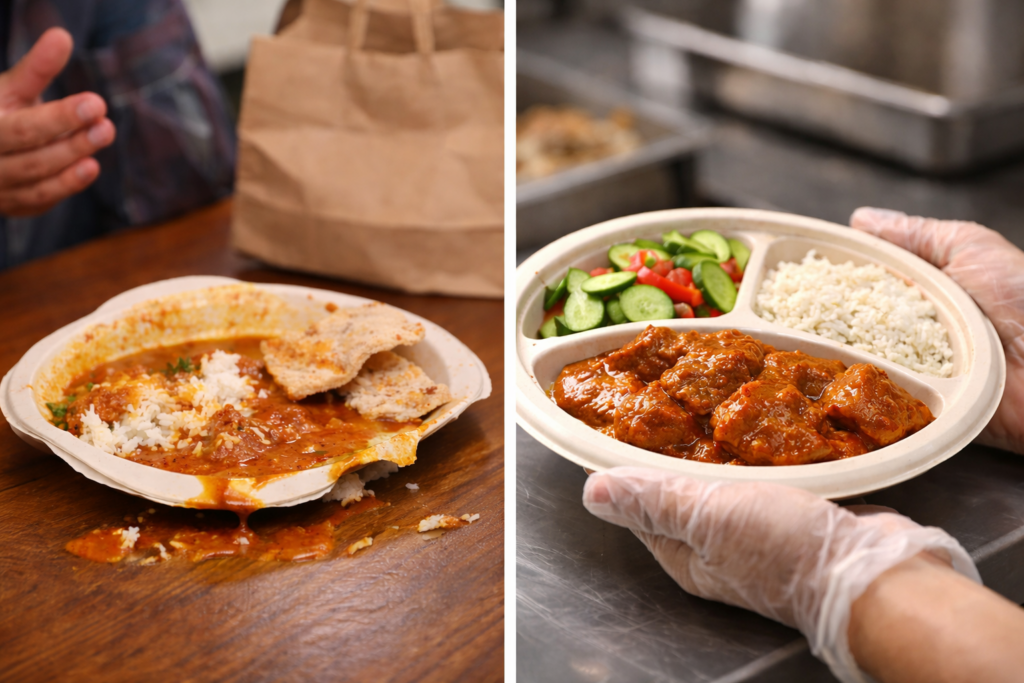
The chemical composition matters because cellulose provides tensile strength, lignin adds rigidity, and the natural oils in the fiber create moderate grease resistance without synthetic coatings. This means finished bagasse tableware handles hot, oily, and wet foods without collapsing, leaking, or releasing toxins.
The 6-Step Manufacturing Process
- Collection: Sugar mills collect fibrous residue immediately after juice extraction. One ton of processed sugarcane yields approximately 250 to 280 kg of usable bagasse.
- Cleaning and pulping: Workers wash the raw material to remove residual sugars and impurities. Mechanical pulpers then break the fibers into a uniform wet slurry.
- Screening: The slurry passes through fine mesh screens to filter out inconsistent fiber fragments, ensuring a homogeneous pulp with optimal bonding characteristics.
- Molding: Hydraulic presses shape the refined pulp into plates, bowls, clamshells, and trays at temperatures between 150°C and 200°C. High pressure compacts fibers into rigid, well-defined forms.
- Drying and sterilization: Molded products enter drying chambers that remove moisture while preserving structural integrity. Sterilization eliminates bacteria, ensuring food-grade safety.
- Quality control and packaging: Each piece undergoes inspection for consistency, strength, and defects. Approved products are stacked, shrink-wrapped, and prepared for distribution.
The entire cycle, from raw bagasse to finished tableware, takes roughly 24 to 48 hours in a modern facility. No synthetic binders, plastic linings, or chemical bleaches are required for high-quality production.
Bagasse Tableware Product Categories and Applications
Modern molding technology allows manufacturers to produce virtually any disposable foodservice item from bagasse pulp. Here’s what’s available and where each product excels.
Plates and Bowls
Round plates come in standard sizes from 6 inches to 12 inches. Compartmented options (2-section, 3-section, and 5-section) serve meal-prep operations and school cafeterias. Bowls range from shallow 180 ml formats to deep 360 ml versions suitable for soups, curries, and grain bowls. Weight capacity typically reaches 500 g per piece.
Clamshell Containers
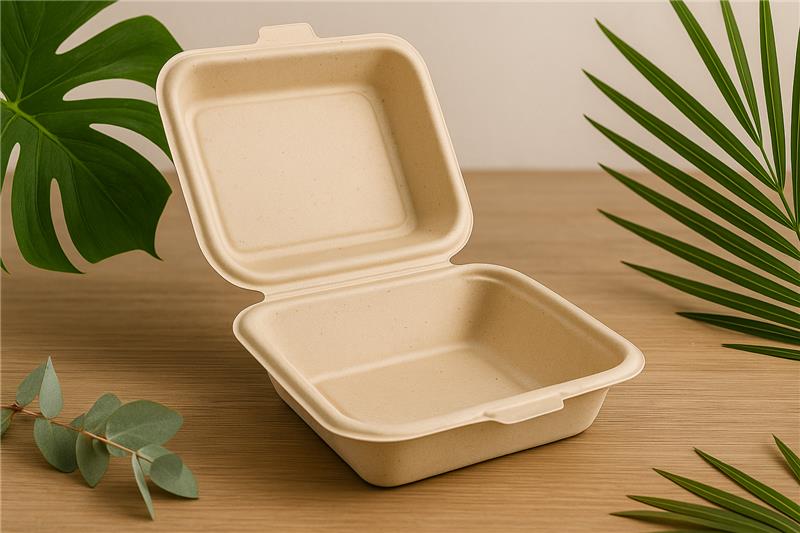
Hinged clamshell designs are the fastest-growing category, driven by the global expansion of food delivery services. Integrated hinges eliminate separate lids. Perforated vents prevent condensation from making food soggy during transit. Standard sizes range from 500 ml to 1500 ml, covering everything from sandwiches to full entrees.
Trays, Cups, and Specialty Items
Bagasse trays work well for catering platters, sushi presentations, and produce packaging. Cup options include hot beverage cups with matching lids. Specialty items like cup carriers, cutlery sets, and custom-branded containers with embossed logos round out full product lines.
Performance Comparison: Bagasse vs. Plastic vs. Paper
Choosing the right disposable material requires balancing durability, safety, environmental impact, and cost. Here’s how bagasse tableware stacks up against the two most common alternatives.
| Property | Bagasse | Plastic (Polystyrene) | Paper |
|---|---|---|---|
| Heat resistance | Up to 120°C | 70 to 90°C | Up to 80°C |
| Grease resistance | Moderate to high | High | Low (unless coated) |
| Microwave safe | Yes | Often no | Limited |
| Freezer safe | Yes (down to -20°C) | Yes | No |
| Compostable | Yes (60 to 90 days) | No (hundreds of years) | Conditional |
| Chemical leaching risk | None (BPA/PFAS-free) | High (styrene, BPA) | Low to moderate |
| Structural rigidity | High | High | Moderate (soggy when wet) |
The data reveals a clear pattern. Bagasse matches plastic on durability and outperforms paper on moisture resistance, while being the only option that fully composts. It also eliminates the chemical leaching risks associated with polystyrene, a growing liability as PFAS regulations tighten globally.
Environmental Impact: The Numbers Behind Bagasse Tableware
Environmental claims deserve hard data. Here’s what the research shows about switching from plastic to bagasse disposables.
- Decomposition speed: Bagasse tableware breaks down within 60 to 90 days in industrial composting facilities. Home composting takes slightly longer, typically 90 to 120 days. Plastic alternatives persist for 400+ years.
- Plastic diversion: Every 1,000 units switched from polystyrene to bagasse keeps 18 to 25 kg of plastic out of landfills.
- Carbon reduction: The same switch cuts CO2-equivalent emissions by 45 to 60 kg per 1,000 units.
- Zero microplastics: Unlike plastic that fragments into microplastics during degradation, bagasse returns entirely to organic matter.
- No additional farmland: Bagasse uses only existing sugarcane waste. Zero additional acreage, water, or fertilizer is needed.
These metrics translate directly into ESG reporting data. Corporate clients increasingly require verified sustainability credentials from their supply chain partners, and bagasse tableware meets certifications including BPI (Biodegradable Products Institute), OK Compost, FDA food contact approval, and EU food safety compliance.
Cost Considerations and Sourcing Strategy
Price is the most common hesitation buyers cite. Bagasse tableware does carry a higher per-unit cost than commodity plastic, typically 15% to 30% more depending on order volume and product type. But that comparison ignores several financial factors that shift the equation.
Hidden Cost Advantages
- Regulatory risk elimination: Businesses already compliant with plastic bans avoid fines and forced product switches later.
- Waste disposal savings: Compostable packaging can reduce commercial waste hauling fees by up to 20% in municipalities with composting infrastructure.
- Brand premium: A 2024 McKinsey survey found that 66% of consumers willingly pay more for sustainably packaged products, allowing businesses to offset material costs through pricing.
- Supply stability: Sugarcane is harvested year-round in tropical regions, creating a more predictable supply chain than petroleum-based plastic resin markets.
Procurement Best Practices
When evaluating bagasse tableware suppliers, prioritize these criteria for consistent quality and reliable delivery.
- Verify certifications: BPI, OK Compost, BRC, HACCP, and BSCI audits confirm manufacturing standards.
- Request samples before committing to large orders. Test with your actual menu items, especially greasy or liquid-heavy dishes.
- Confirm PFAS-free and BPA-free status in writing. Not all bagasse products are created equal.
- Negotiate MOQs (minimum order quantities). Standard items like 9-inch plates typically start at 50,000 pieces; custom-branded products may require 100,000+.
- Plan for 30 to 50 day lead times on standard items and 60 to 90 days on custom orders.
Real-World Applications by Industry
Bagasse tableware performs across a wide range of foodservice settings. Here’s how different industries are deploying it.
Restaurants and Quick-Service Chains
Fast-casual restaurants use clamshell containers for delivery and takeout. The natural steam venting keeps fried foods crispy during transport. Many chains report that customers associate the natural fiber texture with higher food quality, reinforcing brand perception.
Corporate Catering and Events
Companies use compartmented bagasse trays for catered lunches to demonstrate CSR commitments. The clean, natural aesthetic works for board meetings and employee events alike. Certifications provide documentation for annual sustainability reports.
Weddings, Festivals, and Outdoor Events
Event planners appreciate that bagasse plates handle everything from barbecue ribs to wedding cake without bending or leaking. Post-event cleanup is simplified because all serviceware goes into a single compost stream rather than requiring waste sorting.
Schools and Healthcare Facilities
Institutional buyers value the chemical-free composition. With no BPA, PFAS, or styrene, bagasse tableware meets the strict safety requirements of school districts and hospital foodservice operations.
Frequently Asked Questions
What is bagasse tableware made from?
Bagasse tableware is made from the fibrous residue that remains after sugarcane stalks are crushed to extract juice. This agricultural byproduct contains 40% to 50% cellulose, giving it natural strength. The fiber is cleaned, pulped, molded under high heat and pressure, and dried to create plates, bowls, clamshells, trays, and cups.
Is bagasse tableware safe for food contact?
Yes. High-quality bagasse products are food-grade certified and free from BPA, PFAS, and other harmful chemicals. They hold FDA food contact approval and comply with EU food safety standards. Unlike polystyrene, bagasse doesn’t leach toxins when exposed to hot or acidic foods.
How long does bagasse tableware take to decompose?
Under industrial composting conditions, bagasse tableware decomposes within 60 to 90 days. Home composting environments typically require 90 to 120 days. By comparison, plastic disposables can take 400 to 1,000 years to break down, and they fragment into microplastics rather than returning to organic soil matter.
Can you microwave bagasse plates and containers?
Yes. Most bagasse tableware is microwave-safe for standard reheating durations. The material withstands temperatures up to 120°C (248°F) and is also freezer-safe down to -20°C (-4°F), making it suitable for meal prep, storage, and reheating workflows.
How does bagasse compare to plastic and paper tableware?
Bagasse outperforms paper on durability, grease resistance, and moisture handling. It matches plastic on structural strength while being fully compostable and chemical-free. The main trade-off is a 15% to 30% higher per-unit cost compared to commodity plastic, though regulatory compliance savings and brand benefits typically offset this premium.
Is bagasse tableware more expensive than plastic?
Per-unit costs run 15% to 30% higher than basic polystyrene. However, total cost of ownership often favors bagasse when you factor in plastic ban compliance, reduced waste disposal fees, consumer willingness to pay sustainability premiums, and protection against volatile petroleum-based resin pricing.
What certifications should I look for in bagasse tableware?
Look for BPI (Biodegradable Products Institute) certification, OK Compost certification, FDA food contact approval, and EU food safety compliance. For manufacturing quality, BRC, HACCP, and BSCI audit certifications confirm that suppliers meet international food packaging standards.
Making the Switch: Your Next Step
Bagasse tableware has moved well beyond niche eco-product status. It’s a proven, scalable, and certified solution that meets the operational demands of modern foodservice while eliminating the environmental and regulatory liabilities of plastic. The material science is sound, the supply chain is mature, and the consumer demand is unmistakable.
Start with a sample order. Test clamshells with your greasiest menu item, bowls with your hottest soup, and plates with your heaviest entree. Once you see the performance firsthand, scaling up becomes a straightforward procurement decision. Request your free sample kit today and experience the difference sustainable packaging makes for your operation.