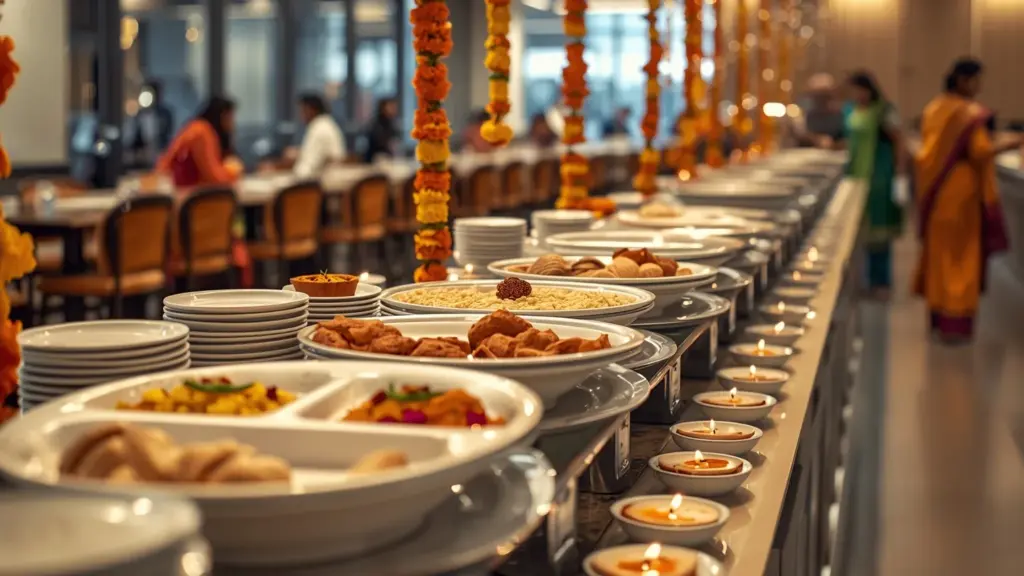
A langar or bhandara can feed a few hundred people or several thousand in a day, often seated in rows, with dal and sabzi served hot from big vessels. The plate has to stay rigid in someone’s hand, keep dal from running into the puri, and arrive in the quantity you planned. This guide is for temple trusts, gurudwara committees, bhandara organisers and the caterers who serve them.
Table of Contents
What makes a good langar or bhandara plate
- It holds liquid. Dal, kadhi and chhole are poured with a ladle. A flat or leaf plate lets them spread into everything else.
- It stays stiff. In a pangat people eat seated on the floor, often holding the plate. A plate that bends once hot dal hits it gets dropped.
- It keeps items apart. Puri and rice go soggy when they sit in gravy for ten minutes. Compartments solve this.
- The supply is predictable. For a weekly langar or an annual bhandara you need the same plate every time, in the quantity you ordered.
- It is allowed. Plastic and thermocol plates fall under India’s single-use plastic ban, and many temples have stopped accepting them anyway.
Which plate for which menu
Most langar and bhandara menus fit one of three set-ups. Each uses plates and bowls from the Pulpcraft range, made from sugarcane bagasse at our plant in Kaimur, Bihar.
| Menu | Plate | Bowl | Why |
|---|---|---|---|
| Langar: dal, roti, rice, sabzi, kheer | 11 inch 4 compartment plate | 180 ml bowl for kheer | Dal and sabzi in their own sections, roti on the large one |
| Bhandara: puri, aloo sabzi, kaddu, halwa | 10 inch 3 compartment plate | 150 ml square bowl for halwa | Puri stays dry, two sabzis stay apart |
| Large bhandara with rice and two gravies | 12 inch 4 compartment plate | 240 ml bowl for dal | Room for bigger portions and refills |
| Prasad only: halwa, boondi, panchamrit | 5 inch triangle plate | 120 ml kiwi bowl | Small, neat portions handed out at the gate |
For the full compartment range, see our guide to bagasse compartment plates. Bagasse holds hot, oily food like puri and halwa without softening; our notes on hot and oily food explain why.
Ordering for a trust, gurudwara or bhandara?
Tell us the menu, the number of people and the date. We will suggest plates and bowls, send samples if you want to test them with your own dal, and quote for the full quantity.
Bagasse vs pattal, dona and thermocol
Leaf pattal and dona are the traditional choice and still the right one for many places. The problems start at scale:
- Pattal and dona: they compost well, but stitched leaf plates let thin dal seep through, and sizes and quality vary from batch to batch because they are handmade. Large orders before festival season can be hard to fill.
- Areca leaf plates: rigid and natural, but supply depends on the leaf harvest and each plate is a little different. We compare them in bagasse vs areca leaf plates.
- Thermocol and plastic: cheap, but banned as single-use items and they end up in rivers and on ghats. We wrote about why thermocol tableware should go and what disposable waste does to hill towns and pilgrim routes.
- Bagasse: moulded to a fixed size and depth, holds dal, stays rigid, and composts after use. It is made from sugarcane fibre, a by-product of sugar mills.
How many plates and bowls to order
Count one plate per person, add about 10 percent for second servings, spills and volunteers, then round up to full boxes. The 10 inch 3 compartment plate ships 500 to a box and the round bowls ship 2,000 to a box, so the maths is simple:
| People expected | Plates with 10% spare | Boxes of 10 inch 3 compartment plates | Boxes of 180 ml bowls |
|---|---|---|---|
| 500 | 550 | 2 (1,000 plates) | 1 (2,000 bowls) |
| 1,000 | 1,100 | 3 (1,500 plates) | 1 (2,000 bowls) |
| 2,500 | 2,750 | 6 (3,000 plates) | 2 (4,000 bowls) |
| 5,000 | 5,500 | 11 (5,500 plates) | 3 (6,000 bowls) |
If the langar runs every day or every week, plan by the month: average daily count times the number of serving days, plus the 10 percent spare. Ordering a month or a quarter at a time means you are not caught short on a busy day.
Storing plates between events
Bagasse plates keep well in a dry store room, off the floor and away from damp walls. Each box of 10 inch 3 compartment plates measures 515 x 255 x 470 mm, so 5,000 plates (ten boxes) take up about one shelf unit. Our guide to shelf life and storage covers humidity and stacking.
After the meal: disposal
Used bagasse plates can go straight into a compost pit with the food scraps, which suits temples and gurudwaras that already compost flowers and kitchen waste. Our composting tips explain how to set one up.
Sizes and box counts
| Product | Size | Depth | Weight | Per packet | Per box |
|---|---|---|---|---|---|
| 10 inch 3 Compartment Plate | 250 mm | 22 mm | 19 g | 25 | 500 |
| 11 inch 4 Compartment Plate | 278 mm | 24.5 mm | 22 g | 25 | 500 |
| 12 inch 4 Compartment Plate | 305 mm | 24.5 mm | 26 g | 25 | 500 |
| 5 inch Triangle Plate | 132 x 120 mm | on request | 3.5 g | 50 | 4,000 |
| 120ml Kiwi Bowl | 80 mm | 35 mm | 4.5 g | on request | on request |
| 150ml Square Bagasse Bowl | 102 mm | 30 mm | 5 g | 50 | 2,000 |
| 180ml Round Bagasse Bowl | 100 mm | 45 mm | 5 g | 50 | 2,000 |
| 240ml Round Bagasse Bowl | 110 mm | 45.5 mm | 6 g | 50 | 2,000 |
Pulpcraft makes every plate, bowl and tray at its own plant in Kaimur, Bihar. The plant holds BRCGS (Packaging Materials, Grade A), ISO 9001, ISO 14001, ISO 45001 and ISO 22000 certification, with SGS and CIPET test reports on the products. You can see the certificates on the About page. Our office is in Varanasi, a short drive from the plant. Tell us your city and we will include freight in the quote.
Planning around a festival? Our guides to the Annakut and chappan bhog list and Chhath Puja samagri cover the menus, and the use and throw plates page lists every plate size we make. Feeding programmes for schools face the same problems; see our piece on the mid-day meal programme.
FAQs
Which plate is best for a langar?
An 11 inch 4 compartment plate suits a full langar of dal, sabzi, rice and roti. For puri-sabzi bhandaras, the 10 inch 3 compartment plate is enough and is lighter (19 g against 22 g).
Can bagasse plates hold hot dal and kadhi?
Yes. They are moulded with raised compartment walls and do not soften with hot dal, kadhi or oily sabzi.
How many plates come in a box?
Compartment plates come 500 to a box (25 to a packet). Round bowls come 2,000 to a box (50 to a packet). The table above lists every size.
Do you supply temples and gurudwaras regularly?
Yes. Trusts can order monthly or before each festival. Tell us your average daily count and we will suggest a reorder plan.
Can we get samples before ordering?
Yes. Ask for samples when you contact us and serve your own dal and halwa on them first.
Are these plates allowed under the plastic ban?
Yes. Bagasse is a plant fibre, not plastic, so it is not covered by the single-use plastic ban.
Get a quote for your langar or bhandara
Send the menu, the expected number of people and the date. We will reply with sizes, box counts and a price.